ITR Filing for NRI: Guide for Non Resident Taxation
1. Introduction
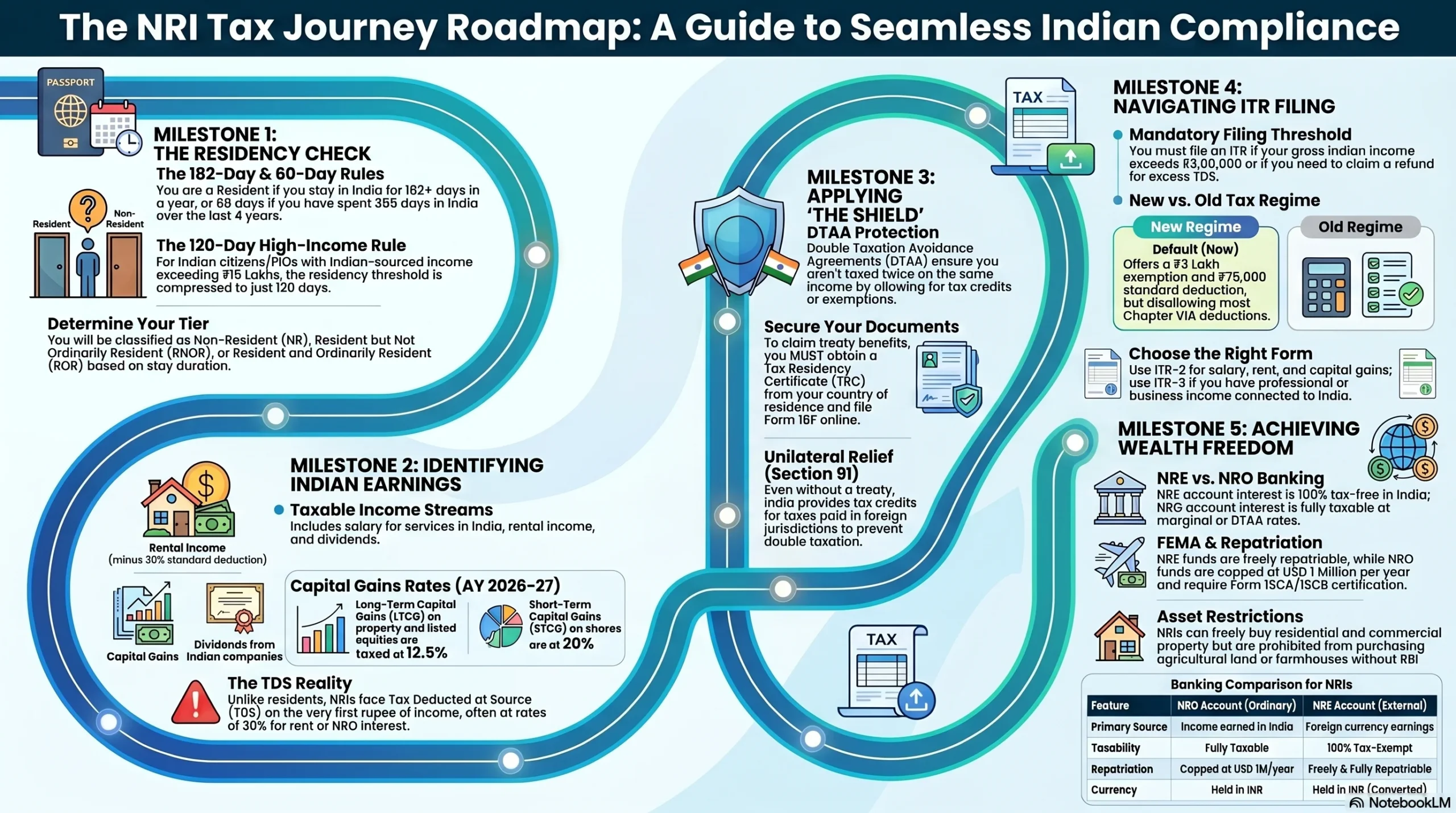
Many of the Non Resident even NRIs find it very difficult to Comply with Indian Taxation specially Income tax filing and disclosure. However, with systematic planning and a clear understanding of Indian regulatory frameworks, ITR filing for NRI can be transformed from a complex administrative hurdle into a streamlined annual compliance routine. The global mobility of modern professionals—such as an Indian software engineer executing cloud architecture solutions in Dubai, or a healthcare consultant or doctor in the United Kingdom managing residential rental portfolios back home—frequently triggers overlapping tax obligations.
The primary financial challenge stems from the overlap of source-based and residence-based tax systems. This creates a clear double-taxation risk, where the exact same stream of income faces tax levies both in the country where it is earned and in India. Failing to reconcile these cross-border earnings exposes individuals to steep non-compliance penalties, high structural withholding rates, and unexpected tax assessments under domestic laws.
As an established name in tax advisory, Shahnawaz & Associates, Chartered Accountants, Mumbai provides tailored solutions to clarify international tax treaties, simplify complex domestic assessments, and maintain full compliance with cross-border regulations. For expatriates looking for comprehensive solutions and precise execution of ITR filing in Mumbai, keeping track of evolving tax laws is essential to safeguarding domestic savings and supporting global growth. Choosing an authoritative approach to tax structuring ensures complete legal alignment while protecting cross-border assets.
2. Residential Status Determination
An individual's physical stay within India determines their total tax exposure for the year. This assessment must be performed independently for every financial year. Under the New Income Tax Act 2025 (retaining the structural principles originally enacted under Section 6 of the Income Tax Act 1961), cross-border individuals are classified into three distinct categories:
A. The Three Tiers of Residential Classification
- Resident and Ordinarily Resident (ROR): The individual is taxed on their worldwide income, covering all earnings accrued inside or outside India.
- Resident but Not Ordinarily Resident (RNOR): The individual is taxed primarily on income originating within India. Foreign income is shielded from Indian tax unless it is derived from a business controlled or a profession set up in India.
- Non-Resident (NR): The individual's tax liability is strictly restricted to income earned, received, or legally deemed to accrue or arise within the borders of India.
B. Statutory Day-Counting Rules
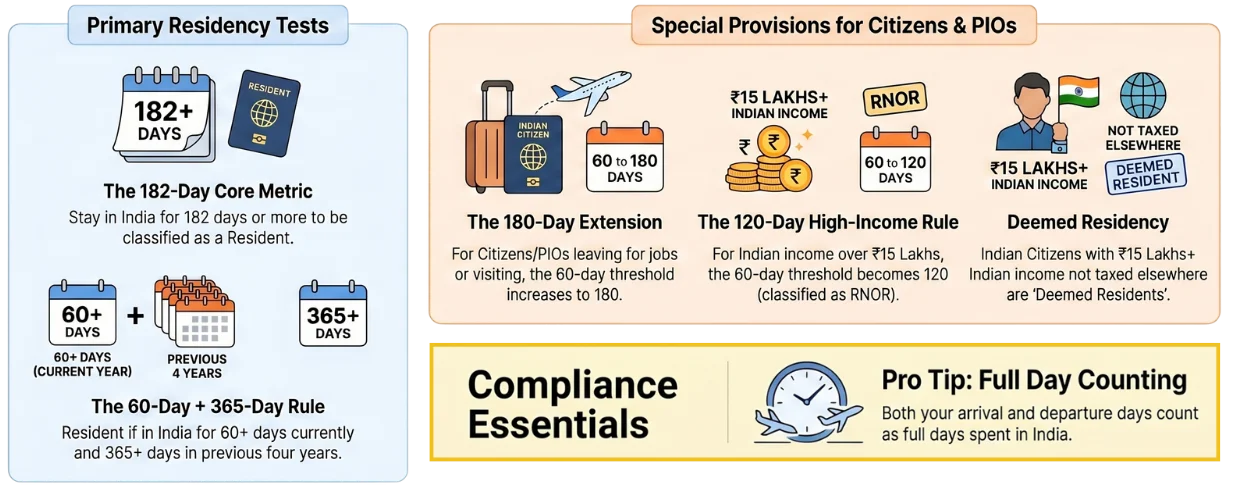
The tax code applies specific day-counting tests to establish these classifications. These core metrics determine whether an individual is classified as an NR or drawn into the domestic tax net:
- The 182-Day Core Metric [Section 6(1)(a) of ITA 1961]: An individual qualifies as an Indian resident if their total physical stay within the territory of India reaches or exceeds 182 days during the relevant financial year.
- The 60-Day + 365-Day Secondary Rule [Section 6(1)(c) of ITA 1961]: An individual is classified as a resident if they stay in India for 60 days or more during the current financial year AND have accumulated 365 days or more of physical presence across the four immediately preceding financial years.
- The 180-Day Indian Origin Extension [Section 6(1)(b) of ITA 1961]: For a citizen of India or a Person of Indian Origin (PIO) who leaves the country for overseas employment, or who visits India while living abroad, the 60-day window under the secondary rule is extended to 180 days.
- The 120-Day Compressed Rule for High-Income Individuals [Finance Act 2020 Amendment to Section 6(1)]: If a citizen of India or a PIO visiting India has total income from Indian sources exceeding ₹15,00,000 (excluding foreign earnings), the 60-day physical presence threshold under the secondary rule is compressed to 120 days. If residency is triggered under this specific condition, the individual is automatically classified under the transitional RNOR status.
- Deemed Residency Rule for Stateless Individuals [Section 6(1A)]: An Indian citizen whose total income from Indian sources exceeds ₹15,00,000 during the financial year is automatically deemed an Indian resident if they are not liable to pay tax in any other country by reason of domicile, residence, or similar criteria. Deemed residents are automatically classified as RNOR.
- The RNOR Qualification Thresholds [Section 6(6) of ITA 1961]: An individual qualifies as an RNOR if they have been a non-resident in 9 out of the 10 preceding financial years, OR if they have spent 729 days or less in India during the 7 preceding financial years.
C. Distinguishing Income Tax Status from FEMA Definitions
Important Regulatory Distinction: Residential status under the Income Tax Act is calculated strictly based on the actual number of days an individual spends in India during a financial period. In contrast, the Foreign Exchange Management Act (FEMA), 1999 determines residency based on the underlying intent and purpose of the stay. Under FEMA, a person becomes a non-resident the moment they leave India to take up overseas employment, operate a business, or stay abroad for an indefinite period. This requires separate tracking across both regulatory frameworks.
D. Source-Based vs. Residence-Based Tax Jurisdictions
International taxation balances source-based and residence-based rules. India uses a combined approach. Residents (ROR) face residence-based taxation, drawing their entire global wealth into the domestic tax base. Non-residents (NR) are governed strictly by source-based taxation rules, restricting India's tax jurisdiction to income tied directly to economic activities within Indian territory. International double tax pacts, such as Article 15 (Dependent Personal Services) or Article 21 (Other Income) of standard DTAA frameworks, protect this distinction by determining which country has the primary right to collect tax.
3. Indian Taxable Income Streams
An NRI must report and account for any income that is legally classified as originating within India. The taxable domestic income streams include:
- Salary Received or Accrued in India: Earnings for services rendered within Indian territory are fully taxable in India, regardless of where the employment contract was signed or the country where the bank account receiving the funds is located.
- Income from Immovable Property: Rental income derived from residential or commercial real estate located in India is taxable. NRIs can claim a standard deduction of 30%, deduct municipal taxes paid, and offset interest paid on home loans.
- Business Connection Profits: Profits generated by an overseas enterprise that operates through a branch, permanent office, or digital business connection within India are taxable to the extent the profits are tied to Indian operations.
- Capital Gains on Indian Assets: Profits from transferring Indian capital assets—such as real estate, corporate equities, mutual funds, or government bonds—are subject to short-term or long-term capital gains tax based on holding periods.
- Dividend and Passive Interest Income: Dividends distributed by Indian companies and interest earned on domestic bank accounts are taxable, subject to specific account exemptions.
Operational Matrix: NRO vs. NRE vs. FCNR Accounts
| Feature Description | Non-Resident Ordinary (NRO) Account | Non-Resident External (NRE) Account | Foreign Currency Non-Resident (FCNR) Account |
|---|---|---|---|
| Primary Source Focus | Managing income earned within India (e.g., local rent, dividends). | Repatriating foreign currency earnings into India in Indian Rupees. | Holding foreign currency savings in fixed deposits in India. |
| Taxability of Interest | Fully Taxable at marginal slab rates or applicable DTAA rates. | Exempt from Tax under Section 10(4)(ii). | Exempt from Tax under Section 10(4)(ii). |
| Repatriation Limits | Capped up to USD 1 Million per financial year under LRS regulations. | Freely and fully repatriable without upper monetary caps. | Freely and fully repatriable without upper monetary caps. |
| Currency Risk Exposure | Borne by the account holder (held in INR). | Borne by the account holder (converted to INR). | None (held directly in designated foreign currencies). |
4. DTAA Treaties & Relief
Double Taxation Avoidance Agreements (DTAAs) are bilateral tax treaties designed to protect taxpayers from being taxed twice on the same income stream. Under Section 159 of the New Income Tax Act 2025 [Section 90 of ITA 1961], provisions within an applicable international treaty override domestic tax laws to the extent they are more beneficial to the taxpayer.
To resolve overlapping tax claims, treaties deploy either the Exemption Method (where the home country completely exempts the source-state income) or the Tax Credit Method (where the residence country taxes the income but allows a deduction for taxes paid in the source country).
Key Global Treaties and Withholding Caps
- United States & Canada: Treaties generally impose a 15% cap on interest withholding and a 15% cap on royalties and fees for included services (FIS).
- United Kingdom & Germany: These agreements standardize the taxation of dividends and business profits, limiting withholding on technical fees and interest to 10% or 15% depending on the specific nature of the transaction.
- Singapore & Australia: These treaties provide robust frameworks for managing capital gains and corporate service fees, though they include strict limitation of benefits (LOB) clauses to prevent treaty shopping.
Statutory Compliance Documentation
To successfully claim lower tax rates or exemptions under a DTAA, an NRI must collect and submit the following mandatory documents:
- Tax Residency Certificate (TRC): An official certificate issued by the tax authority of the NRI's country of residence confirming their regulatory status.
- Form 10F: A statutory self-declaration containing key details like tax identification numbers, nationality, and the duration of the TRC. Filing Form 10F online via the Indian Income Tax e-filing portal is now mandatory for all taxpayers seeking treaty benefits.
Strategic Case Example: The United Kingdom Framework
Consider an NRI doctor residing in London who owns a commercial property in Mumbai yielding ₹12,00,000 annually, alongside an Indian equity portfolio. Under the India-UK DTAA, the rental income is taxed first in India under source rules. When filing taxes in the UK, the doctor declares this income but claims a Foreign Tax Credit (FTC) for the Indian taxes paid, ensuring the income isn't taxed twice. For their Indian equity portfolio, the doctor can use the treaty to cap withholding taxes on dividends at 15%, bypassing higher domestic rates.
DTAA Dynamics with Gulf / Zero-Tax Jurisdictions
India maintains active DTAAs with Gulf Cooperation Council (GCC) nations, including the UAE, Saudi Arabia, Qatar, Kuwait, Bahrain, and Oman. Even though these countries levy minimal or zero personal income tax, obtaining a valid Tax Residency Certificate from their respective ministries remains mandatory. Income earned directly within the Gulf is exempt from Indian tax, provided the individual maintains non-resident status and avoids the physical day thresholds in India. However, under the Section 6(1A) deemed residency rule, an Indian citizen living in the Gulf with over ₹15,00,000 in Indian-sourced income could be deemed an Indian resident if they cannot prove they are legally subject to a tax framework abroad.
Unilateral Relief Under Section 91
If an NRI earns income in a jurisdiction that does not share a DTAA with India, domestic law provides relief under Section 91. India offers unilateral tax credit relief to residents who pay tax on foreign income, calculated using the formula:
Unilateral Tax Credit = Foreign Income Taxed in India × Min(Indian Tax Rate, Foreign Tax Rate)
This calculation ensures that the taxpayer receives structural relief even without an active bilateral treaty.
5. NRI Statutory TDS Matrix
Unlike resident individuals, who benefit from minimum threshold exemptions before Tax Deducted at Source (TDS) is applied, NRIs face withholding tax on all Indian-sourced income from the very first rupee. The following table highlights the applicable statutory withholding rates for Assessment Year 2026-27:
| Section (New IT Act 2025) | Section [ITA 1961] | Nature of Inbound Income Stream | TDS Rate (Without DTAA) | Standard TDS Rate (With DTAA Example) |
|---|---|---|---|---|
| Section 393(2) | [Section 195] | Interest on NRO Savings Accounts / Fixed Deposits | 30% + Surcharge & Cess | 10% to 15% (e.g., India-USA Treaty) |
| Section 393(2) | [Section 195] | Gross Rental Income from Immovable Property | 30% + Surcharge & Cess | Restricted via Permanent Establishment rules |
| Section 393(2) | [Section 195] | Short-Term Capital Gains (STCG) on Equity Shares | 20% + Surcharge & Cess | 15% under specific treaty limitations |
| Section 393(2) | [Section 195] | Long-Term Capital Gains (LTCG) on Equity Shares | 12.5% + Surcharge & Cess | 10% to 12.5% based on treaty clauses |
| Section 393(2) | [Section 195] | Long-Term Capital Gains (LTCG) on Property Sale | 20% + Surcharge & Cess | 10% to 12.5% subject to local asset rules |
| Section 382 | [Section 194LBA] | Income Distributions from Business Trusts (REIT/InvIT) | 10% + Surcharge & Cess | 5% under specialized cross-border clauses |
| Section 393(2) | [Section 195] | Fees for Technical or Professional Services | 20% + Surcharge & Cess | 10% to 15% based on treaty classifications |
Key Withholding Compliance Rules
- Property Purchase Obligations: Under Section 393(2) [Section 195 of ITA 1961], anyone buying real estate from an NRI must deduct TDS on the entire sale consideration, not just the capital gains, unless the NRI provides a specific lower-deduction certificate.
- No Basic Thresholds: Residents enjoy minimum thresholds before tax is withheld on interest or rent. For NRIs, tax is deducted on the entire amount from the very first rupee.
- Lower/Nil TDS Certificates: To prevent excessive withholding, an NRI can apply for a lower or nil TDS certificate under Section 406 [Section 197 of ITA 1961] by submitting Form 13 online. The tax department evaluates the NRI's actual tax liability and issues a certificate directing the payer to deduct tax at a reduced rate.
6. Mandatory ITR Filing Rules
An NRI must file an Indian Income Tax Return if they meet specific financial criteria:
A. Mandatory Filing Thresholds
- Gross Total Income Exceeding Thresholds: Filing is mandatory if gross taxable income from Indian sources (before deductions under Chapter VIA) exceeds the basic exemption limit of ₹3,00,000 within the financial year.
- Claiming Tax Refunds: If an NRI has faced high TDS withholding (e.g., 30% on rent or NRO interest) and their actual tax liability is lower, they must file an ITR to claim a refund.
- Capital Gains Realization: Filing is required if the NRI has generated taxable short-term or long-term capital gains from transferring Indian assets, even if the total income falls below the standard exemption limit.
B. Exemptions and Forms
- Exemption from Filing [Section 115G of ITA 1961]: An NRI does not need to file an ITR if their only Indian income consists of investment income (like dividends or interest) or long-term capital gains, and the correct TDS has already been deducted.
- Applicable ITR Forms: ITR-2 is used by most NRIs with salary, rental income, capital gains, or interest. ITR-3 is required if the NRI earns profits from a business or profession connected to India.
- Aadhaar-PAN Linkage Rules: The tax department has relaxed Aadhaar-PAN linkage rules for NRIs who do not possess an Aadhaar card, provided they update their non-resident status in the PAN database. This prevents their PAN from becoming inoperative.
- E-Verification Methods: NRIs can electronically verify their returns using an Electronic Verification Code (EVC) generated through an NRO bank account, via a Digital Signature Certificate (DSC), or by mailing a signed physical copy of ITR-V to the Centralized Processing Centre (CPC) in Bengaluru.
7. Old vs. New Tax Regimes
The choice between the Old and New Tax Regimes significantly impacts an NRI's tax liability. Under the New Income Tax Act 2025, the New Tax Regime is established as the default choice for all individual taxpayers. The following table outlines the key structural differences for Assessment Year 2026-27:
| Particulars / Structural Component | New Tax Regime (New IT Act 2025) | Old Tax Regime (Income Tax Act, 1961) |
|---|---|---|
| Basic Exemption Limit | Increased to ₹3,00,000 | Set at ₹2,50,000 for non-residents |
| Standard Deduction (Salary) | Fully Available up to ₹75,000 | Set at ₹50,000 |
| House Rent Allowance (HRA) | Completely Disallowed | Available to salaried NRIs with Indian rentals |
| Chapter VIA Deductions (80C, 80D) | Completely Disallowed (Except 80CCD(2)) | Fully Available (up to ₹1,50,000 for 80C) |
| LTCG on Equity (Section 112A) | Taxed at 12.5% (Exempt up to ₹1,25,000) | Taxed at 12.5% (Exempt up to ₹1,25,000) |
| STCG on Equity (Section 111A) | Taxed at a flat rate of 20% | Taxed at a flat rate of 20% |
| Special Rates on NRO Interest | Taxed at regular progressive slabs | Taxed at regular progressive slabs |
| Tax Rebate Under Section 87A | Restricted strictly to resident individuals | Not available to non-resident individuals |
| Surcharge Caps | Max surcharge capped at 25% | Surcharge scales up to 37% for top brackets |
| Default Setting and Switching | The New Regime is the Default System. | Requires filing Form 10-IEA to opt out annually. |
8. Cross-Border GST Rules
The Inter-State and International dynamics of the Goods and Services Tax (GST) framework impose strict compliance requirements on non-residents interacting with the Indian economy.
A. NRI as a Service Recipient
When an NRI receives services from an Indian business while inside the country, standard GST rates (typically 18%) apply. If an NRI-owned overseas business imports services from an Indian provider, the transaction is treated as an "Export of Services" and is zero-rated, provided it meets all the criteria under Section 2(6) of the IGST Act, 2017—including receiving payment in convertible foreign exchange.
B. Real Estate Transactions
- Under-Construction Property Purchases: If an NRI buys an under-construction apartment or commercial space in India from a developer, the transaction is subject to standard GST (1% for affordable housing, 5% for regular residential units, and 12% for commercial units).
- Property Sales: Selling completed real estate or vacant land does not attract GST. However, the transaction remains subject to local stamp duties and income tax TDS rules.
- Commercial Rentals: If an NRI rents out commercial property located in India and their total annual domestic turnover exceeds ₹20,00,000 (or ₹10,00,000 in specialized hill states), they must obtain GST registration and remit the applicable 18% tax.
C. OIDAR Services
Under the Online Information and Database Access or Retrieval (OIDAR) rules, foreign digital service providers delivering content (like cloud storage, streaming, or online gaming) to non-taxable online recipients in India must register and pay GST. If an NRI uses these services while residing in India, the transaction falls under this framework.
9. FEMA & Banking Regulations
Managing Indian wealth as an NRI requires strict compliance with both tax laws and the Foreign Exchange Management Act (FEMA), 1999.
- Banking Regulations: NRIs are legally prohibited from maintaining standard resident savings bank accounts in India. Upon changing their residential status, all existing accounts must be converted into Non-Resident Ordinary (NRO) or Non-Resident External (NRE) accounts.
- Repatriation Caps: Capital held in NRE and FCNR accounts can be freely repatriated abroad without limits. However, funds in NRO accounts—such as domestic rental income or asset sale proceeds—are capped at USD 1 Million per financial year under the Liberalised Remittance Scheme (LRS), requiring a formal CA certificate in Form 15CA and Form 15CB.
- Gifts and Inheritances: NRIs can freely inherit real estate and assets in India. They can also receive monetary gifts from resident relatives up to the LRS limit of USD 2,50,000 per year without violating exchange controls.
- Real Estate Restrictions: Under RBI regulations, NRIs can freely buy residential and commercial properties in India. However, they are strictly prohibited from purchasing agricultural land, plantation property, or farmhouses without explicit prior clearance from the Reserve Bank of India.
10. Precedent Case Laws
1. Aditya Kumari v. Income Tax Officer (ITAT Delhi)
Brief Facts:
An Indian citizen living abroad visited India frequently to manage family assets. The assessing officer counted their arrival and departure days in a way that pushed their total stay to 183 days, triggering resident status.
Core Legal Issue:
Do arrival and departure days count as full days spent in India?
Judicial Ruling:
The Tribunal ruled that if part of a day is spent in India, that entire day must be counted toward the physical stay calculation.
Relevance to NRIs:
NRIs must track their travel dates carefully, as partial days count fully toward the 182-day residency threshold.
2. Siva Swaminathan v. Deputy Commissioner of Income Tax (ITAT Chennai)
Brief Facts:
An NRI claimed lower withholding tax on interest income under a DTAA but failed to provide a formal Tax Residency Certificate (TRC) from their home country.
Core Legal Issue:
Can a taxpayer claim DTAA benefits without a valid TRC?
Judicial Ruling:
The court held that providing a TRC is a mandatory statutory requirement under Section 90(4). Without it, treaty benefits cannot be granted, regardless of other evidence.
Relevance to NRIs:
NRIs must obtain a valid TRC and file Form 10F online to successfully secure treaty benefits.
3. M/s Global Sourcing v. Commissioner of Central GST (AAAR)
Brief Facts:
An Indian firm provided referral, business development, and client coordination services to overseas businesses. They treated these services as zero-rated exports.
Core Legal Issue:
Did these activities qualify as an export of services or an "intermediary service" taxable at 18%?
Judicial Ruling:
The Authority ruled that because the firm acted as a broker facilitating services between foreign entities and Indian suppliers, they qualified as an "intermediary" under Section 2(13) of the IGST Act. The place of supply was therefore deemed to be within India, making the services taxable at 18%.
Relevance to NRIs:
Tech consultants and freelancers working with foreign clients must carefully structure their service agreements to avoid being classified under the intermediary GST trap.
4. Deedika Syed v. Income Tax Officer (ITAT Hyderabad)
Brief Facts:
An NRI sold an inherited residential house in India and reinvested the proceeds into a new residential property within the statutory timeframe to claim an exemption under Section 54. The assessing officer denied the exemption, arguing that Section 54 was restricted to residents.
Core Legal Issue:
Are NRIs eligible for capital gains exemptions under Section 54?
Judicial Ruling:
The Tribunal ruled in favor of the taxpayer, clarifying that Section 54 applies to the asset itself, not the residential status of the seller.
Relevance to NRIs:
NRIs can use capital gains exemptions (like Section 54 and 54EC) to optimize their tax liability when selling property in India, provided they meet the investment timelines.
5. Transmission Corporation of AP Ltd v. Commissioner of Income Tax (Supreme Court)
Brief Facts:
A resident buyer purchased an asset from a non-resident seller but failed to deduct TDS under Section 195, assuming the transaction was not profitable for the seller.
Core Legal Issue:
Is a buyer required to deduct TDS on the entire payment or only on the estimated profit margin?
Judicial Ruling:
The Supreme Court held that the obligation to deduct tax under Section 195 applies to the entire gross payment unless the buyer or seller has obtained a lower-deduction certificate from the tax department.
Relevance to NRIs:
Anyone buying property from an NRI must deduct TDS on the gross purchase price to avoid facing steep penalties as an "assessee-in-default."
11. Recent Legislative Shifts
- Finance Act 2024 Capital Gains Overhaul: The tax landscape saw a major shift with the removal of indexation benefits for real estate capital gains. All long-term capital gains on property are now taxed at a flat rate of 12.5% instead of the previous 20% with indexation. Additionally, the long-term capital gains tax rate for listed equities increased from 10% to 12.5%, while short-term gains under Section 111A rose to 20%.
- New Income Tax Act 2025 Structural Transition: The tax code has been streamlined, leading to the renumbering of several key provisions. Core rules like presumptive professional taxation have moved to Section 46, while standard tax audit triggers are consolidated under Section 44.
- Mandatory Electronic Form 10F Filing: The Central Board of Direct Taxes (CBDT) has removed manual exceptions for Form 10F. Non-residents seeking DTAA benefits must now register on the e-filing portal using a temporary tax ID and file Form 10F electronically.
- TCS Hikes on Foreign Remittances: Tax Collected at Source (TCS) on overseas remittances under the Liberalised Remittance Scheme (LRS) has risen to 20% for amounts exceeding ₹7,00,000 (except for education and medical purposes), requiring careful cash flow planning for returning NRIs.
12. Compliance Enforcement Alerts
- Faceless Assessment and Scrutiny: The tax department has extended its automated faceless assessment system to cover non-resident returns, using data algorithms to flag mismatches without human intervention.
- NRO Account High-Value Audits: The CBDT has launched targeted campaigns analyzing data from NRO accounts that show large cash deposits or high-volume transfers, prompting inquiries into undeclared domestic business activities.
- FATCA and CRS Automatic Data Sharing: Under the Foreign Account Tax Compliance Act (FATCA) and the Common Reporting Standard (CRS), India automatically exchanges financial account data with over 100 countries. This allows the tax department to reconcile an NRI's Indian disclosures with their overseas financial footprints.
- Strict Section 195 Enforcement: Tax authorities have intensified checks on real estate registrations involving NRI sellers, issuing notices to buyers who fail to deduct the correct TDS on the gross transaction value.
13. Risk/Benefit Analysis
Favorable Considerations
- DTAA Protection: Protects earned income from being taxed twice, especially for professionals working in the Gulf.
- Tax Exemptions: Interest earned on NRE and FCNR accounts remains completely exempt from Indian income tax.
- RNOR Status: Returning NRIs can claim RNOR status for up to three years, shielding their global income from Indian taxes during the transition.
- Reduced Withholding: Section 197 certificates allow NRIs to lower their TDS rates based on their actual tax liability.
Adverse Considerations
- Deemed Residency Trap: High-income individuals in tax-free countries risk being deemed Indian residents under Section 6(1A) if their Indian-sourced income exceeds ₹15,00,000.
- Intermediary GST Risks: Remote consultants and freelancers face potential 18% GST liabilities if their service contracts are classified as intermediary work.
- Loss of Property Indexation: The removal of indexation benefits can lead to higher tax liabilities for NRIs selling older properties in India.
- Mandatory Electronic Filings: Strict requirements for online Form 10F submissions and automated data matching leave little room for compliance errors.
14. Professional Support
Filing an income tax return as an NRI requires balancing physical day counts, domestic income sources, and international treaty provisions. With automated data sharing and strict enforcement of withholding taxes under Section 195, maintaining clean, proactive compliance is essential to protecting your domestic wealth.
If you need to optimize your Indian tax liability, file an accurate return, or resolve outstanding tax notices, contact our expert team today.
Need Expert Cross-Border Tax Assistance?
Protect your global income and ensure complete compliance under the New Income Tax Act 2025. Contact our team today for professional NRI tax advisory and smooth ITR filing services.
Schedule a Consultation