Real estate registrations feeding AIS. Credit card spends flagged to the Compliance Portal. Crypto exchanges reporting under SFT. And now — foreign bank accounts, overseas investments and offshore income arriving straight from tax authorities abroad into your AIS. The message from CBDT hasn't changed in a decade; only the reach has widened. This one just closed the last visible gap: your money outside India.
1What the Order Actually Says
On 8 July 2026, CBDT issued an order under Section 119 of the Income-tax Act, 1961 read with Rule 114-I(2) of the Income-tax Rules, 1962, and also read with Section 536 of the new Income-tax Act, 2025. It authorises the Director General of Income-tax (Systems), Delhi to upload financial information received under the Automatic Exchange of Information (AEOI) framework — the data India receives from other countries under Section 90/90A tax treaties — directly into taxpayers' Annual Information Statement and Form 26AS.
Two timelines apply:
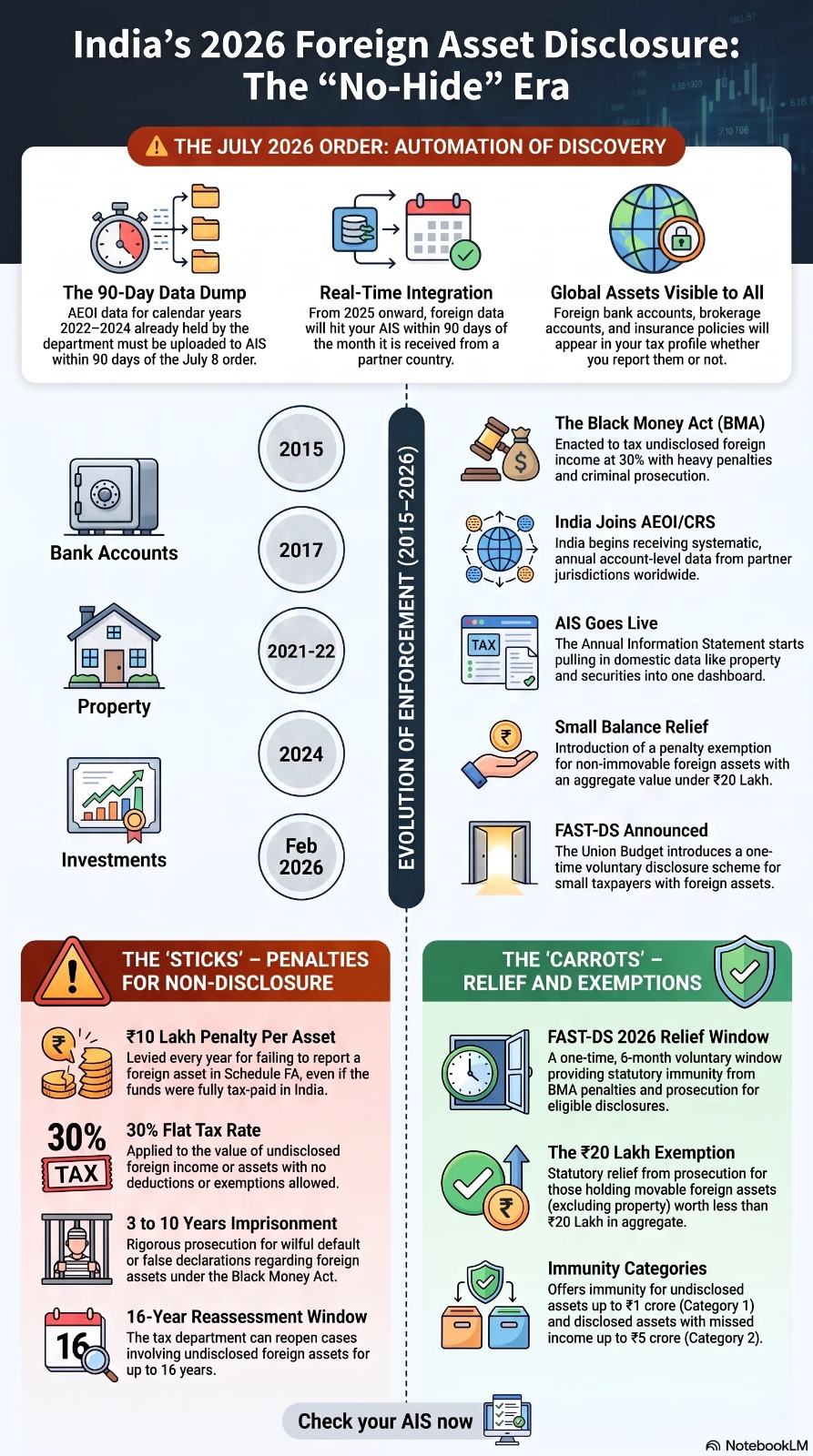
- Calendar years 2022, 2023 and 2024: AEOI data already in the Department's possession must be uploaded within 90 days of the order.
- Calendar year 2025 onward: Data will be uploaded within 90 days from the end of the month in which it is actually received from the partner jurisdiction.
In practical terms — if you held a foreign bank account, brokerage account, insurance policy or similar reportable asset any time between January 2022 and December 2025, and the country where it's held participates in AEOI, that information is landing in your AIS whether or not you ever mentioned it in your ITR.
2Why This Isn't New — It's the Next Step
We have tracked this pattern closely over the last few years. The government's approach to widening the tax net has followed a consistent playbook: identify a category of transactions, mandate third-party reporting of that category, reflect it in AIS/26AS, then nudge or notify non-filers. Property registrations, high-value credit card payments, cash deposits, mutual fund transactions, and crypto trades have all gone through this cycle already. Global assets and offshore income are simply the newest — and arguably the largest — category to receive the same treatment.
What makes this order notable is the intent behind it. CBDT is not springing a surprise. It is giving taxpayers visibility of the very data it will use to cross-check their returns — effectively inviting self-correction before enforcement.
3India's Global-Income Net: Year by Year
The Black Money (Undisclosed Foreign Income and Assets) and Imposition of Tax Act, 2015 came into force from 1 July 2015 (charging provisions effective 1 April 2016), taxing undisclosed foreign income and assets at a flat 30% with a separate penalty of three times the tax, plus criminal prosecution for wilful default.
India began receiving account-level data from partner jurisdictions under the OECD's Common Reporting Standard (CRS) and the India-US FATCA arrangement, giving the Department its first systematic feed of resident-held foreign accounts.
An amendment extended BMA's reach to persons who are non-residents today but were resident in India when the foreign asset was acquired or the income was earned — closing an obvious escape route.
The Annual Information Statement replaced the older Form 26AS-only view, progressively pulling in dozens of Statement of Financial Transaction (SFT) categories — property, securities, mutual funds, foreign remittances, credit cards — into one taxpayer-facing dashboard.
CBDT ran a targeted SMS/email campaign for AY 2024-25, using existing AEOI data to nudge resident taxpayers who appeared to hold foreign accounts or assets but had not completed Schedule FA / Schedule FSI — with an open invitation to file a revised return.
Finance Act 2024 carved out an exemption: BMA penalty under Section 43 does not apply where foreign movable assets (other than immovable property) aggregate up to ₹20 lakh — recognising that not every missed tick-mark is concealment.
Union Budget 2026 introduced the Foreign Assets of Small Taxpayers – Disclosure Scheme, a one-time six-month voluntary window offering full immunity from penalty and prosecution for taxpayers with modest undisclosed foreign assets or income.
The order covered in this article. The final piece: taxpayers can now see, in their own AIS, the same foreign-account information the Department already holds — for CY2022 to CY2025, and continuing forward.
4What is AEOI / CRS, in Plain Terms?
Under the OECD's Common Reporting Standard, banks and financial institutions in over 100 participating countries identify accounts held by tax residents of other countries and report those account balances and income to their own tax authority. That authority then automatically shares the data with the account holder's home tax administration — once a year, without any request being made. India receives this data as a resident-country tax authority, and the country where you hold the account is the one reporting you.
This is separate from, but works alongside, FATCA reporting for US-linked accounts and information exchanged bilaterally under specific Double Taxation Avoidance Agreements referred to in Sections 90 and 90A of the Income-tax Act.
5The Legal Backbone: Schedule FA & the Black Money Act
Schedule FA — Income Tax Return
Mandatory for every Resident and Ordinarily Resident (ROR) individual to disclose foreign bank accounts, custodial accounts, equity/debt interests, insurance contracts, trusts, immovable property and signing authority held abroad — irrespective of value, and irrespective of whether the underlying income is taxable in India.
Schedule FSI — Foreign Source Income
Used to report income earned from foreign sources and to claim foreign tax credit under Section 90/90A read with Form 67, cross-referenced against the country-wise details in Schedule FA.
Black Money Act, 2015 — Section 43
Penalises failure to furnish, or furnishing inaccurate particulars of, any foreign asset or foreign income in the ITR — a flat ₹10 lakh penalty per year, applied even where the underlying funds are fully accounted for in India.
Black Money Act — Sections 49 & 50
Provide for criminal prosecution — rigorous imprisonment ranging from 3 months to 10 years depending on the offence — for wilful evasion or false declarations relating to foreign assets and income.
Income-tax Act, 2025 — Section 536
The successor provision under the new Income-tax Act, 2025 (applicable from Tax Year 2026-27) that continues CBDT's authority to prescribe procedures for AIS/Form 26AS reporting, cited alongside Section 119 of the 1961 Act in the July 2026 order.
Reassessment Window
Cases involving undisclosed foreign income or assets fall outside the normal reassessment time limits — the Department can reopen such assessments for up to sixteen years, far beyond the standard limitation period.
6What Non-Disclosure Actually Costs You
Per Undisclosed Asset
Flat penalty under Section 43, BMA — per year, per asset, regardless of value.
Flat Tax Rate
On undisclosed foreign income/asset value, with no deductions, exemptions or loss set-off allowed.
Prosecution
Rigorous imprisonment for wilful non-disclosure or false declaration under BMA.
Reassessment
Extended look-back period the Department can apply for undisclosed foreign assets.
7FAST-DS 2026: The Relief Window You Shouldn't Ignore
Foreign Assets of Small Taxpayers — Disclosure Scheme, 2026
Announced in Budget 2026 and enacted under the Income-tax Act, 2025, FAST-DS 2026 offers a one-time, six-month voluntary window for eligible taxpayers to come clean on foreign assets or income that were never reported — in exchange for statutory immunity from penalty and prosecution, including under the Black Money Act.
Category 1 — never disclosed: undisclosed foreign income/asset value up to ₹1 crore; tax payable and immunity granted on valid disclosure.
Category 2 — asset disclosed but income missed: aggregate foreign asset value up to ₹5 crore, with similar immunity on regularisation.
Separate relief: no prosecution at all for non-immovable foreign assets aggregating below ₹20 lakh, applied retrospectively from 1 October 2024.
The commencement date for the six-month window is notified separately by the Central Government — once notified, it cannot be availed retroactively for declarations made before that date. This is exactly the kind of window that should be used with professional guidance, not left to a last-minute scramble.
8What You Should Do Now
- Log in to the e-Filing portal and review your AIS/TIS for any foreign account, investment, insurance or property entries reflected under the AEOI category, for calendar years 2022 through 2025.
- Cross-check every foreign bank account, brokerage account, ESOP/RSU holding, and overseas property against what was actually reported in Schedule FA and Schedule FSI of the corresponding ITRs.
- Where a mismatch or omission is found, evaluate whether a revised return, an updated return under Section 139(8A), or the FAST-DS 2026 window (once notified) is the appropriate route — the right choice depends on the year, the value involved, and whether the original return was even filed.
- Reconcile foreign income already offered to tax in India against foreign tax credit claims in Form 67, to avoid double taxation or DTAA relief being denied for lack of matching disclosure.
- Where the aggregate undisclosed value is modest, assess eligibility for the ₹20 lakh prosecution immunity or FAST-DS 2026 relief before it is misread as a case for aggressive concealment.
- Keep supporting documents — foreign bank statements, broker contract notes, employer ESOP letters, property purchase deeds — ready and organised; AEOI data will need to be reconciled line by line, not estimated.
✔ Do
- Review AIS proactively rather than waiting for a notice
- Disclose even small or dormant foreign accounts in Schedule FA
- Take professional advice before choosing revised return vs. FAST-DS 2026
- Keep a residency-status trail (days in India) supporting your ROR classification
✘ Don't
- Assume a closed or low-balance foreign account is too small to matter
- Wait for a compliance notice to start reconciling
- Mix up disclosure of the asset with disclosure of income from the asset — both are required separately
- Attempt a DIY revised return for foreign asset matters without expert review
9Compliance Calendar — What's Due, When
| Milestone | Applicable Period | Action Point |
|---|---|---|
| AEOI data upload — CY2022 to CY2024 | Within 90 days of 08.07.2026 order | Review AIS as data appears |
| AEOI data upload — CY2025 onward | Within 90 days of month of receipt | Ongoing AIS monitoring recommended |
| Revised return, AY 2025-26 | Up to 31 December 2026 (subject to Act provisions) | Correct Schedule FA/FSI omissions |
| Updated return, Section 139(8A) | Up to 48 months from end of relevant AY | For earlier years, with additional tax |
| FAST-DS 2026 window | 6 months from date notified by CG | One-time immunity opportunity — awaiting notification |
10What Typically Triggers Scrutiny
- AEOI-reported foreign account with no corresponding Schedule FA entry in the ITR of that year
- Foreign income visible in AEOI data but no matching Schedule FSI disclosure or Form 67 claim
- Large or sudden foreign remittances (Form 15CC data) inconsistent with declared income levels
- ESOP/RSU vesting or sale by employees of foreign/US parent entities left unreported
- Foreign property purchase or sale not reflected in Schedule FA in the year of transaction
- Residential status (ROR vs. RNOR vs. NR) claimed inconsistently with actual days-in-India records
Don't Let AEOI Data Reach You Before Your CA Does
Foreign asset disclosure isn't a box-ticking exercise — wrong classification, missed years, or the wrong relief route can turn a genuine oversight into a Black Money Act case. Talk to us before you revise, before you disclose, and before the notice arrives.
Book a Foreign Asset Review