Most trustees don't file returns every day — most of you run schools, hospitals, gaushalas, temples or welfare programmes, and tax filing is one task among a hundred others. So this article skips the technical detour and gets straight to what actually matters for someone sitting on a trust's board this year.
1What is ITR-7? (In Plain Words)
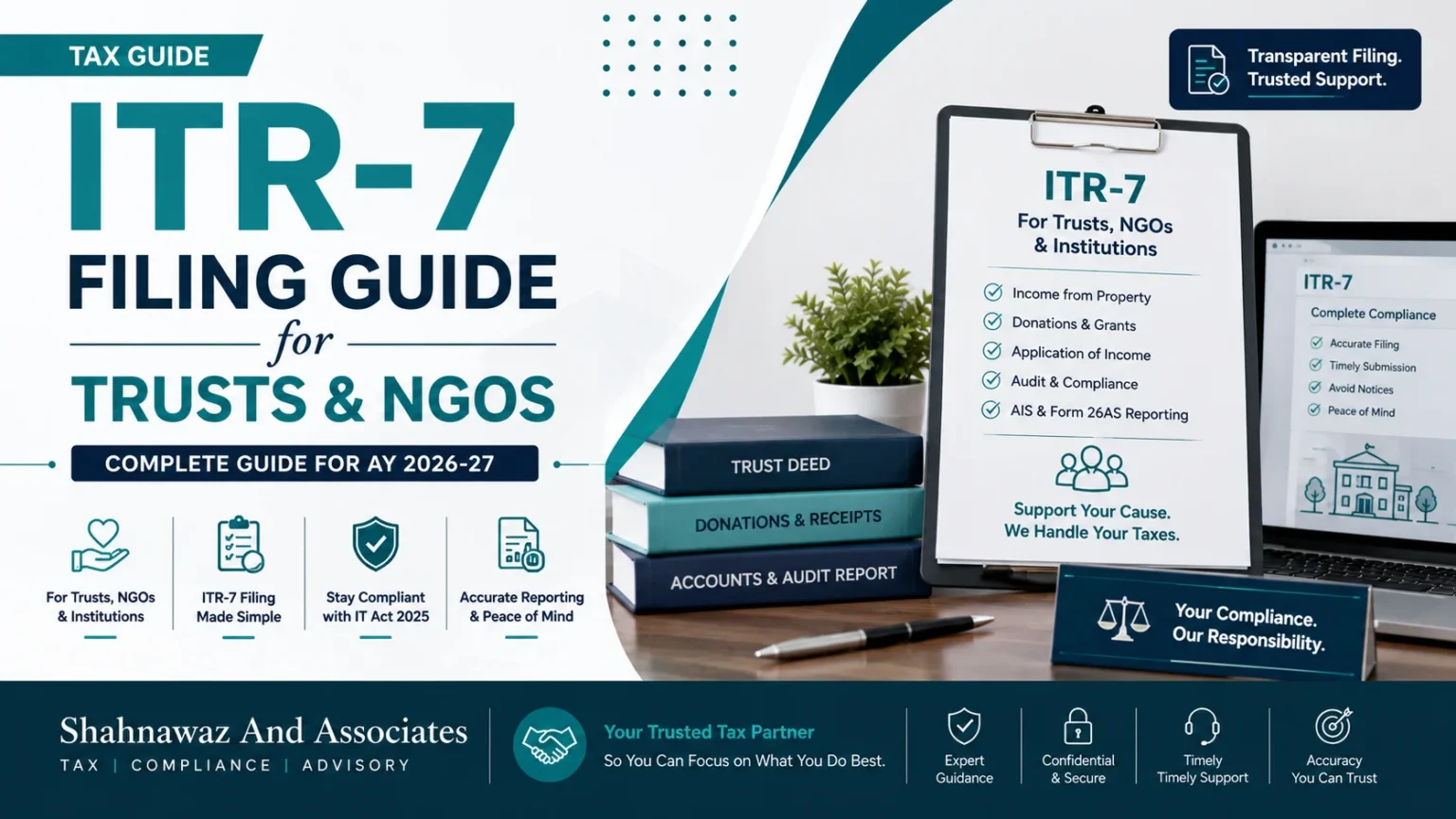
ITR-7 is the income tax return form meant only for entities that exist to serve a public or specified purpose — not for individuals or ordinary businesses. Think of it as the "special purpose" return: it is used by charitable and religious trusts, political parties, research institutions, universities, colleges and similar bodies that are asking the tax department to treat their income as exempt because of the nature of their work.
Filing ITR-7 is how a trust tells the Income Tax Department: "Here is our income, here is how we spent it on our charitable objects, and here is why we should not be taxed like a normal business." Even if your trust has genuinely spent every rupee on its charitable purpose, that story only counts if it's told correctly in ITR-7.
2Who Must File ITR-7 — Applicable Assessees
Section 139(4A)
Charitable or religious trusts, and any person holding property under a legal obligation wholly or partly for charitable or religious purposes — the most common category, covering the vast majority of NGOs and public trusts.
Section 139(4B)
Political parties, where income (before claiming exemption under Section 13A) exceeds the basic exemption limit.
Section 139(4C)
Scientific research associations, news agencies, professional bodies, and specified associations claiming exemption under Section 10.
Section 139(4D)
Universities, colleges and institutions not required to file returns under any other provision, including those approved under Section 10(23C).
In short: if your entity is claiming exemption under Section 11/12 (registered charitable trusts) or under the specified clauses of Section 10(23C) (educational or medical institutions), ITR-7 is your form — regardless of whether you're structured as a trust, a society, or a Section 8 company.
3Who Should NOT File ITR-7
This is where trustees most commonly go wrong — and it deserves more attention than most guides give it.
✘ Do Not Use ITR-7 If
- Your trust is not registered under Section 12AB and has not been approved under Section 10(23C) — and is not claiming any exemption. Such a trust is taxed like any other body of individuals and should generally use ITR-5.
- You run a private family trust that simply holds property or investments for named beneficiaries, with no charitable or religious object and no exemption claim — this is an ITR-5 case, decided by the trust deed, not ITR-7.
- Your entity is a Section 8 company or charitable company that is not claiming exemption in a given year — it may need to fall back to ITR-6 for that year instead.
- Your 12A/12AB registration has lapsed, been cancelled, or was never granted, and you have not separately been approved under Section 10(23C) — filing ITR-7 without a live registration invites a straightforward rejection of the exemption claim, not a mere technical query.
✔ Use ITR-7 If
- You hold a valid 12A/12AB registration or 10(23C) approval and are claiming exemption for the year
- You are a political party filing under Section 13A
- You are a university, college or research institution approved under the relevant clauses of Section 10
4Extra Clauses You Won't Find in Other ITR Forms
ITR-7 is structurally heavier than ITR-1 to ITR-6 because it has to capture not just income, but how that income was applied to charitable objects — and whether the trust followed the specific rules that come with claiming exemption. Some clauses unique to ITR-7:
Schedule A
Detailed, purpose-wise disclosure of how income was applied — relief of the poor, education, medical relief, environment, and more — split between revenue and capital expenditure.
Schedule J
A complete statement of where the trust's funds are invested as on the last day of the year — mandatory for checking compliance with the permitted modes of investment under Section 11(5).
Schedule D & DA
Tracks deemed application of income and accumulated income taxed in earlier years — used when a trust carries forward unspent amounts under Section 11(1B)/11(3).
Schedule IA
Reconciles accumulated income from earlier years that has now been taxed, so the department can see the full lifecycle of accumulated funds.
Section 115TD (Exit Tax)
Applies when a trust converts to a non-charitable form, merges with a non-similar entity, or fails to transfer assets to another eligible institution on dissolution — taxing the "accreted income" at maximum marginal rate.
Section 115BBC (Anonymous Donations)
Anonymous donations above the threshold are taxed at a flat 30%, with a specific disclosure requirement absent from every other ITR form.
5New Clauses Added in Recent Years
ITR-7 has been rewritten almost every year since AY 2023-24. Here's what's changed, in order:
- AY 2023-24: Form 10B and Form 10BB were unified — applicability now depends on income level and foreign involvement, not on whether you're registered under 12AB or approved under 10(23C).
- AY 2025-26 (income of FY 2024-25): Since the Union Budget of 23 July 2024 changed capital gains tax rates mid-year, ITR-7 for this year requires capital gains to be reported separately for transactions before and after 23 July 2024. The same year also brought: capital loss on share buybacks allowed only if the matching dividend is disclosed as "Income from Other Sources"; a new field capturing whether Form 10 (for accumulation under Section 11(2)) was filed, and on what date; mandatory disclosure of registration/approval details (the 12AB order or 10(23C) approval reference); and expanded TDS section-code reporting for tighter reconciliation with Form 26AS.
- AY 2026-27: CBDT notified a revised ITR-7 via the Income-tax (Seventh Amendment) Rules, 2026, published on 30 March 2026, tightening reporting accuracy further for trusts, NGOs, political parties and institutions. This return continues to be filed under the Income-tax Act, 1961 — the new Income-tax Act, 2025, though already enacted and in force from 1 April 2026, applies only from Tax Year 2026-27 onward (income earned after 1 April 2026), so it will first apply to the ITR-7 filed next year, not this one.
6Form 10B / 10BB — Why It Must Be Filed Before ITR-7
If your trust's total income (before claiming Section 11/12 exemption) crosses ₹5 crore in the year, or the trust has received foreign contributions, or applied any income outside India, you must file Form 10B. If none of these apply and your income stays within the ₹5 crore threshold, Form 10BB applies instead. Both are audit reports — signed and filed by a Chartered Accountant after auditing your books — and both must be filed before your ITR-7.
Threshold
Above this, or with foreign involvement, Form 10B applies; otherwise Form 10BB.
Audit Report Due Date
One month before the ITR-7 due date, for the relevant assessment year.
ITR-7 Due Date
For entities requiring an audit report — after Form 10B/10BB has been filed and accepted.
Why the sequence matters
Filing the wrong form — 10B where 10BB applies, or vice versa — is treated as non-furnishing of the audit report altogether, which means your exemption claim under Sections 11 and 12, or Section 10(23C), can be denied outright. And because ITR-7 pulls figures like the 15% accumulation amount directly from the audit report, filing ITR-7 before your CA has finalised and you have accepted Form 10B/10BB almost always forces a correction later. The safest sequence is always: books finalised → audit completed → Form 10B/10BB filed and accepted with your DSC/EVC → then ITR-7.
7The Matching Game: 80G Receipts, Form 10B/10BB & ITR-7
This is the part most trustees underestimate. Three separate filings — your donation receipts, your audit report, and your ITR-7 — describe the same money. If the numbers in any one of them don't agree with the other two, it becomes visible to the department almost automatically, and it isn't just your trust's problem — it can cost your donors their 80G deduction too.
- Donation receipts and Form 10BD/10BE: Every donation eligible for an 80G certificate to the donor must be reported by the trust in the annual Statement of Donations (Form 10BD), which then generates Form 10BE certificates for donors. The total donations reported here must match what your books and audit report show as receipts for the year.
- Form 10B/10BB and ITR-7: Figures such as income applied to charitable objects, the 15% amount set apart, and accumulated income must be entered identically in both the audit report and the corresponding schedule of ITR-7. Even small rounding mismatches between Schedule A/Part B-TI of ITR-7 and the corresponding fields of Form 10B/10BB are a known, well-documented source of processing errors and notices.
- The donor's angle: If a donor claims an 80G deduction based on your certificate, but your trust's own ITR-7/10B doesn't reflect that donation consistently, it can trigger a mismatch on the donor's side during their return processing — which reflects poorly on your trust's credibility with supporters, quite apart from any departmental consequence to the trust itself.
85 Points Every Trustee Must Check Before Filing
Is your registration actually live?
Check your 12AB registration validity or 10(23C) approval order before assuming exemption applies — a lapsed or under-renewal registration changes your filing position entirely.
Have you applied at least 85% of income?
If not, has valid accumulation been made under Section 11(2) with Form 10 filed on time? Under-application without proper accumulation is one of the most common causes of exemption denial.
Is Form 10B or 10BB filed and accepted — the correct one?
Confirm which form applies based on your income level and any foreign contribution or overseas application of funds, and that it's filed and DSC/EVC-verified before you touch ITR-7.
Do your donation records match your 80G disclosures?
Reconcile Form 10BD donation totals against your books and audit report before certificates go out to donors.
Are your investments compliant with Section 11(5)?
Funds parked outside the permitted modes of investment — even temporarily — can attract tax on that portion, and must be disclosed correctly in Schedule J.
9Compliance Calendar for Trusts (AY 2026-27)
| Compliance | Typical Due Date | Notes |
|---|---|---|
| Form 10BD (Statement of Donations) | 31 May following the financial year | Generates Form 10BE certificates for donors |
| Form 9A / Form 10 (accumulation) | Before ITR filing due date | Required to validly carry forward unspent income |
| Form 10B / Form 10BB (Audit Report) | 30 September of the Assessment Year | Must be filed and accepted before ITR-7 |
| ITR-7 | 31 October of the Assessment Year | For entities requiring an audit report |
| Form 10-IEA / other elective forms | Before ITR-7 due date, where applicable | Only where the specific regime option is being exercised |
10Quick FAQs
Can a trust file ITR-7 without a PAN in the trust's name?
No — a PAN registered in the name of the trust or institution is mandatory before ITR-7 can be filed.
What happens if we file ITR-7 late?
Late fees under Section 234F apply, along with interest, and — more importantly — delayed or missed audit report filing can independently result in loss of exemption for the year.
Our trust has no taxable income this year — do we still need to file?
Yes. ITR-7 must still be filed to formally claim exemption and stay compliant, even where the net tax payable is nil.
Can a private trust ever need ITR-7?
Only if it is registered and claims exemption under Sections 11/12 or the relevant 10(23C) clauses. A purely private/family trust distributing to named beneficiaries, without such a claim, does not use ITR-7.
Get Your Trust's ITR-7 Filed Right — the First Time
Wrong form choice, a missed Form 10B/10BB, or a mismatch between your 80G receipts and your audit report can put your trust's exemption at risk. Let our team review your registration status, audit report, and ITR-7 together before you file.
Book a Trust Compliance Review