GST ITC Denied Because Your Supplier Didn't Pay Tax? Relief May Finally Be Coming
You paid your supplier in full, GST included. Your supplier pocketed the tax and vanished. Months later, you get a notice asking you to pay that same GST again — with interest. This has been one of the most unfair corners of GST since 2017. Here's the full story, and why that may be about to change.
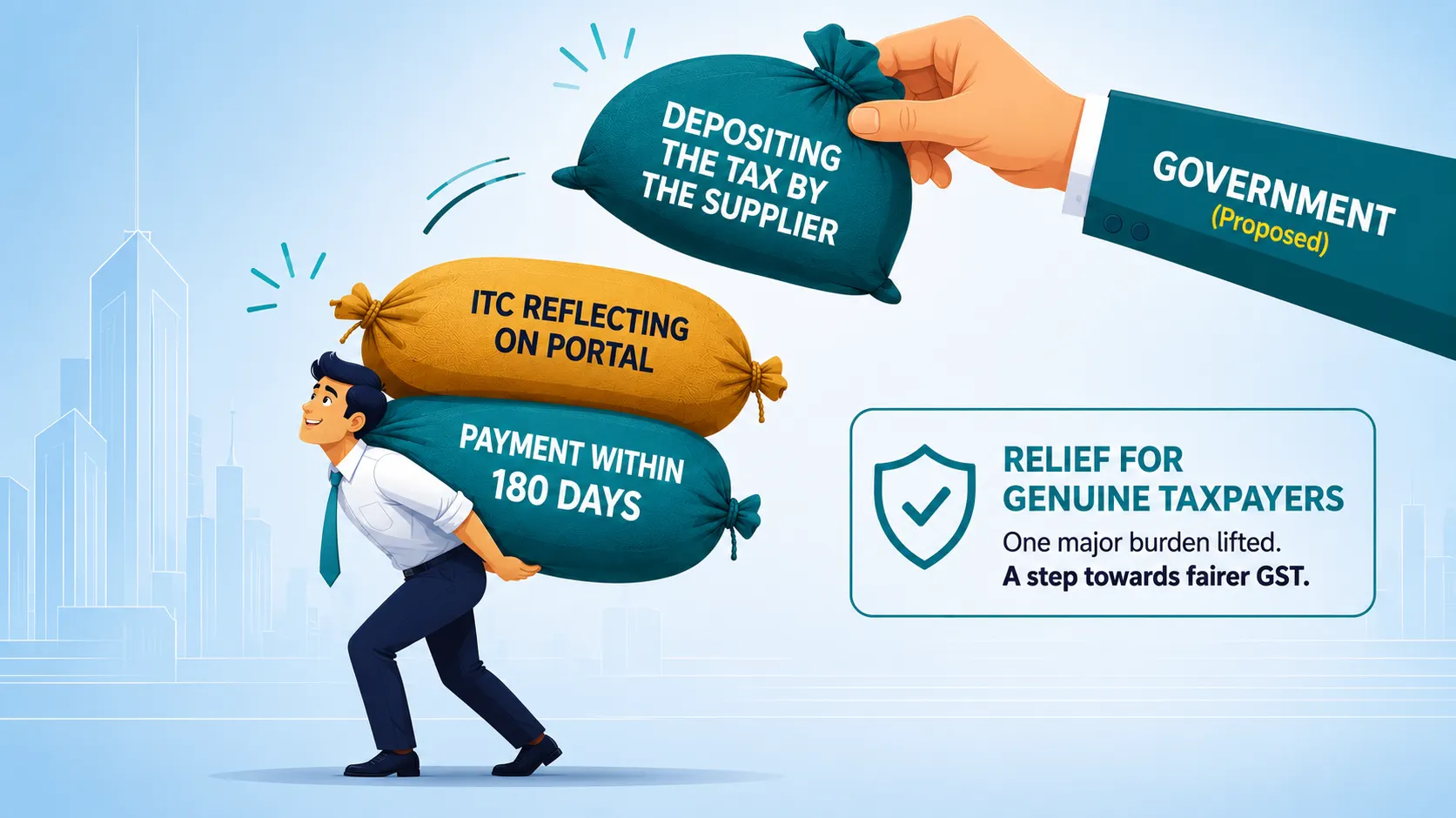
On 11 July 2026, the GST Council's law committee cleared a proposal that could reshape one of the regime's most contentious rules: buyers may no longer lose their input tax credit simply because a supplier failed to deposit tax with the government. This article explains how we got here, what the law says today, the court battles genuine taxpayers have fought, and what actually changes once the GST Council gives its final nod.
1The Problem, in One Line
You buy goods or services, pay the full invoice value including GST through your bank account, and claim input tax credit (ITC) on the strength of a valid tax invoice. Everything on your side is clean. But if your supplier never deposits that GST with the government — whether out of fraud, financial distress, or simply shutting shop — the tax department has, for years, come after you, the buyer, to reverse the credit and pay it again, with 18% annual interest.
Industry bodies have argued this for nearly a decade: a buyer has no real way to check whether a supplier will deposit tax next month. You can verify a GSTIN is active today; you cannot police someone else's compliance forever. Yet under the current framework, that is effectively the burden GST places on you.
2A Quick History: How We Got Here
When GST launched on 1 July 2017, Section 16(2) of the CGST Act laid down four conditions for claiming ITC: possession of a tax invoice, receipt of goods or services, filing of the return, and — the clause that causes all the trouble — clause (c): the tax charged on the supply must actually have been paid to the government by the supplier, either in cash or through their own credit ledger.
Read literally, this means your right to credit depends on someone else's honesty. In the early years, matching was meant to happen through GSTR-2, a return that was supposed to auto-populate purchases and let buyers reconcile them against supplier filings. GSTR-2 was suspended within months of GST's launch because the technology couldn't handle it, and GSTR-2A — a read-only, auto-generated statement — took its place as an informal reference point, not a legal condition.
The CBIC itself clarified this twice, in press releases dated 4 May 2018 and 18 October 2018, stating that the GSTR-1/GSTR-2A facility exists purely to help taxpayers self-assess and does not restrict a buyer's ability to claim ITC on the basis of Section 16 alone. Despite this, field officers continued raising demands purely on GSTR-2A/GSTR-3B mismatches — setting up years of avoidable litigation.
That changed formally on 1 January 2022, when the Finance Act, 2021 inserted Section 16(2)(aa) into the CGST Act. For the first time, matching stopped being a mere administrative convenience and became a statutory condition in its own right: ITC can be claimed only if the supplier has furnished the invoice details in their GSTR-1 (or via the Invoice Furnishing Facility) and those details have been communicated to the buyer in GSTR-2B. This is the clause that gives GSTR-2B its legal teeth today — it converted what CBIC had earlier called a "facilitation tool" into an enforceable pre-condition for ITC, which is also why GSTR-2B, not GSTR-2A, is now the document every buyer must reconcile against before filing GSTR-3B.
3What the Law Actually Demands From You Today
Two separate provisions trip up genuine buyers, and it helps to know them apart:
Supplier's Tax Payment
ITC is conditional on the supplier actually depositing the tax charged on your invoice — the root of the supplier-default problem.
Second Proviso, Sec 16(2)
If you don't pay your supplier (invoice value + GST) within 180 days of the invoice date, you must reverse the ITC yourself, plus 18% interest under Section 50 — reclaimable once you do pay.
Interest on Wrong Availment & Utilisation
Charged under Section 50(3) only where wrongly availed ITC was also utilised to pay output tax — not on credit that merely sat unused in your Electronic Credit Ledger.
Here's the sequence that plays out for a real buyer: the department first issues an intimation in Form DRC-01A flagging the mismatch. You can pay up voluntarily or reply explaining your position. If your reply isn't accepted, a formal show cause notice follows — traditionally under Section 73 if there's no fraud alleged (interest, no penalty if paid before the notice), or Section 74 if fraud, suppression, or misstatement is alleged (100% penalty on top of tax and interest). For financial years up to FY 2023-24, this Section 73/74 framework still governs pending and new notices. But the Finance (No. 2) Act, 2024 inserted a new Section 74A, which consolidates both fraud and non-fraud demand proceedings into a single, unified timeline for FY 2024-25 onwards — 42 months to issue a notice, 12 months to pass an order (extendable by 6), and penalty severity still turning on whether fraud is alleged, but under one section rather than two. If you receive a notice for FY 2024-25 or later citing Section 73 or 74 instead of 74A, that alone can be grounds to challenge it. Genuine buyers caught in a supplier's default almost always end up defending themselves in the non-fraud track — under Section 73 for older years, or Section 74A for FY 2024-25 onward — paying interest (where utilisation is proven) for a mistake that was never theirs.
4How Big Is This Problem, Really? The Numbers
This isn't a fringe issue. According to a written reply given in the Rajya Sabha in December 2025, detected ITC-fraud cases and their value have climbed sharply over four years:
| Financial Year | Fake ITC Cases Detected | Value Involved |
|---|---|---|
| FY 2022-23 | 7,231 | ₹24,140 crore |
| FY 2023-24 | 9,190 | ₹36,374 crore |
| FY 2024-25 | 15,283 | ₹58,772 crore |
| FY 2025-26 (up to Oct 2025) | 24,109 | ₹41,664 crore |
Separately, the Finance Ministry told the Lok Sabha in August 2025 that GST authorities detected total evasion of roughly ₹7.08 lakh crore between FY21 and FY25 — including fake ITC of about ₹1.79 lakh crore across 91,370 cases — with over ₹1.29 lakh crore recovered through voluntary deposits in that period.
This is exactly why the government has been cautious about loosening Section 16(2)(c): a genuine chunk of "supplier default" cases are actually engineered fraud using shell firms and fake invoicing rackets. But it's also why compliant buyers keep getting caught in the same net meant for fraudsters — which is precisely the imbalance the new proposal is trying to fix.
Figures as per Rajya Sabha Unstarred Question No. 1019 (9 December 2025) and Lok Sabha reply by the Minister of State for Finance (August 2025), based on data published on gstcouncil.gov.in and cbic.gov.in.
5When Courts Stepped In for the Genuine Buyer
Since the law itself didn't distinguish fraud from honest mistake, the burden shifted to the courts — and a fairly consistent line of judgments has developed in the buyer's favour.
Suncraft Energy Pvt. Ltd. vs Assistant Commissioner of State Tax (Calcutta HC, 2023; SLP dismissed by Supreme Court, December 2023)
Suncraft had paid its supplier in full, including GST, but some invoices didn't reflect in its GSTR-2A because the supplier hadn't filed GSTR-1 correctly. The department demanded reversal purely on this mismatch. The Calcutta High Court held that a buyer who has a valid invoice, has received the goods or services, and has paid the supplier cannot be forced to reverse ITC without the department first investigating and pursuing the defaulting supplier. Recovery from the buyer, the court said, is justified only in exceptional situations — collusion between buyer and supplier, a missing supplier, closure of the supplier's business, or the supplier having no assets to recover from. The Supreme Court declined to interfere with this ruling, effectively settling the principle for genuine buyers nationwide.
The Calcutta High Court leaned on an earlier Supreme Court ruling in Bharti Airtel Ltd., which had already established that GSTR-2A is a facilitation tool for self-assessment, not a statutory bar on a buyer's independently earned right to ITC under Section 16. Similar reasoning followed in Arise India Ltd. under the pre-GST VAT regime, which the Suncraft bench also cited.
The practical takeaway from this line of cases: the "chase the seller first" principle exists, but until now it lived in case law — built by taxpayers who could afford to litigate — not in the statute itself.
6Not Every Court Agreed
Litigation on this point hasn't been entirely one-sided. The Patna High Court, in Aastha Enterprises vs State of Bihar, took a stricter view — reading Section 16(2)(c) at face value and upholding recovery from the buyer even where the buyer had paid the supplier in full. Legal commentators have noted this ruling didn't examine the Suncraft Energy or Bharti Airtel reasoning in detail, which limits how far it has been followed elsewhere. Still, its existence shows the legal position has genuinely been unsettled — different High Courts reading the same clause differently is rarely good news for a taxpayer trying to plan with certainty. That inconsistency is itself a strong argument for Parliament to simply fix the provision, rather than leaving buyers to hope they get the "right" bench.
7The New GST Council Proposal (July 2026) — What Actually Changes
This is where the news from this month comes in. On 11 July 2026, the GST Council's law committee cleared a proposal — after it had already been approved by the fitment committee — to statutorily protect a buyer's ITC in supplier-default cases. Under the proposal:
- ITC would be protected if the supplier has reported the invoice, causing it to reflect in the buyer's GSTR-2B.
- The buyer must be able to show that payment — including the GST component — was made through banking channels or other prescribed payment documents.
- Where both conditions are met, the tax department would pursue recovery from the defaulting supplier, not the buyer.
A senior government official was quoted in the Economic Times describing this as a long-pending industry demand, now cleared by both committees and likely to be placed before the GST Council at its next meeting. Officials have also confirmed the provision wasn't taken lightly — it was originally built into the law because of genuine, large-scale fake-invoicing and tax-evasion cases, not to inconvenience honest businesses. The Council will still need to decide the finer print, including how a "bona fide purchaser" will be defined and verified.
8What This Means for You as a Genuine Buyer
✔ Good news, once approved
- No more automatic ITC reversal just because a supplier defaulted after the fact
- The burden shifts to proving your own compliance — invoice, GSTR-2B reflection, banking proof — not chasing your supplier's tax deposits
- Should meaningfully cut down future litigation of the Suncraft Energy kind
✘ What it won't fix
- The 180-day payment rule (second proviso to Section 16(2)) is untouched — you must still pay your supplier within 180 days or reverse ITC yourself
- Genuine fraud, collusion, or fake invoicing cases will still see ITC denied and pursued aggressively
- It's a proposal, not law yet — it still needs formal GST Council approval and a notification
9Until It's Formally Approved — What You Should Do Now
Always pay through banking channels
Cash payments to suppliers, even where legally permitted, will leave you unable to benefit from this proposed protection. Bank transfer, cheque, or other prescribed payment documents are what will matter.
Reconcile GSTR-2B every month — don't wait for year-end
If an invoice hasn't reflected in your GSTR-2B, follow up with the supplier immediately. Under both current law and the proposed change, GSTR-2B reflection remains central to your claim.
Keep your 180-day payment clock in view
This rule isn't going away. Track invoice dates against payment dates for every supplier, especially where credit terms run long.
Don't ignore a DRC-01A
If you do get a pre-notice for an ITC mismatch, respond within the given time with your invoice, GSTR-2B extract, and bank payment proof — the Suncraft Energy precedent is currently your strongest defence if the department hasn't investigated your supplier first.
Vet new suppliers before extending credit
Check GSTIN status and filing regularity on the GST portal before onboarding a new, unfamiliar supplier — especially for high-value, recurring purchases.
10Quick FAQs
Has this proposal become law yet?
No. As of this article, it has cleared the fitment and law committees only. It still needs to be approved by the GST Council and then notified through an amendment before it takes legal effect.
If my supplier already defaulted and I already reversed ITC, will I get it back once this is approved?
That depends entirely on the transition provisions the government notifies alongside the amendment — these typically aren't retrospective unless specifically stated. We'd recommend waiting for the final notification before assuming past reversals will be refunded.
Does GSTR-2B reflection alone protect my ITC even today?
Not automatically under the letter of the law, but the Suncraft Energy precedent (upheld by the Supreme Court) gives you a strong argument that the department must investigate and pursue your supplier first, rather than reversing your credit outright, provided you meet the genuine conditions of Section 16(2).
What if my supplier is untraceable or has shut down?
This is exactly the kind of exceptional circumstance courts have carved out where recovery from the buyer may still be justified — so supplier due diligence at the time of onboarding matters more than ever.
Got a GST Notice Over a Supplier's Default?
If you're facing an ITC reversal demand, DRC-01A, or show cause notice because a supplier didn't deposit tax, don't respond alone. Let us review your invoices, GSTR-2B, and payment trail, and build the right response.
Talk to Us About Your Notice