Tax Audit Series · FY 2025-26 Filing
Form 3CA, 3CB & 3CD Explained Clause by Clause: The Complete Tax Auditor's Reference
Every particular in the tax audit report, decoded clause by clause — with the common reporting errors auditors keep running into, and verified case law for the clauses that matter most.

If you've ever stared at a blank Form 3CD wondering exactly what "particulars" a clause is really asking for, you're not alone — even experienced practitioners keep a reference close at hand every season. This article walks through every clause of Form 3CA, Form 3CB, and all 44 items of Form 3CD, explains what each one requires in plain language, flags the reporting errors that come up repeatedly in practice, and links the handful of clauses where a Supreme Court ruling genuinely changes how you report. If you'd rather have our team prepare and file the report for you, our Tax Audit Services team handles this end to end every season.
Quick Orientation
- Form 3CA is used when the assessee's accounts are already audited under another law (e.g., the Companies Act or LLP Act).
- Form 3CB is used when there is no other statutory audit — the tax auditor is examining the balance sheet and P&L for the first time.
- Form 3CD is the 44-item statement of particulars annexed to either Form 3CA or Form 3CB — the form itself never changes, only its covering report does.
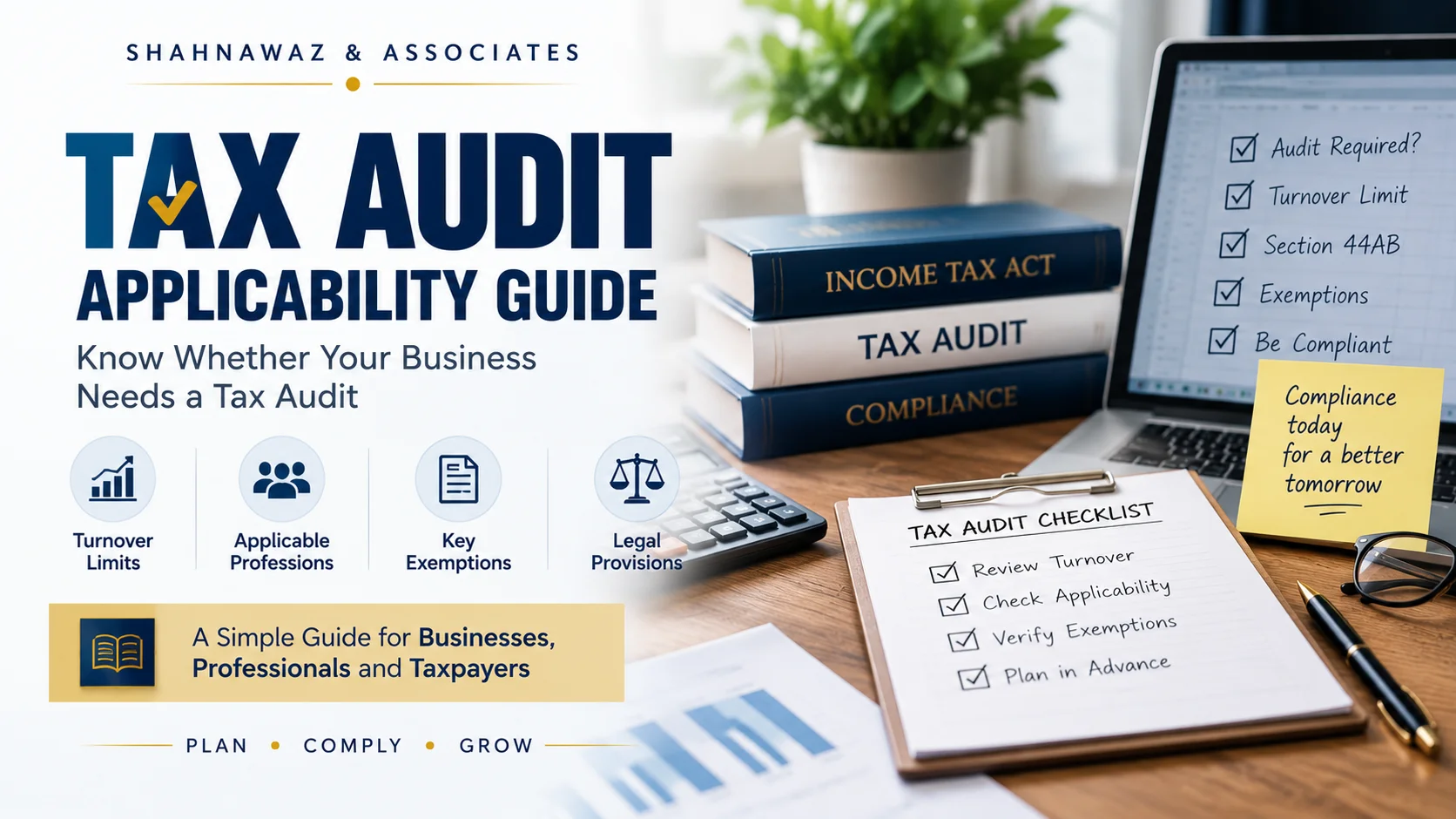
- Not sure which threshold triggers a tax audit in the first place? Read our companion guide, Tax Audit Applicability for Every Entity, before you get to the reporting stage.
Table of Contents
1Form No. 3CA – When and Why
Form 3CA is the covering audit report used when the assessee's books have already been audited under some other law — typically the Companies Act, 2013 or the LLP Act, 2008. It does not duplicate that audit; instead, it formally attaches the statutory audit report, the audited balance sheet and P&L, and every schedule the relevant Act requires as annexures, and records that a separate statement of particulars is being furnished in Form 3CD.
What the tax auditor actually certifies
That the particulars in Form 3CD are true and correct, to the best of their information and belief, based on examination of the books of account and other relevant documents — subject to any observations or qualifications noted.
When the tax auditor differs from the statutory auditor
This is governed by SA 600, "Using the Work of Another Auditor" — the tax auditor must name the statutory auditor and can rely on that audit only within the bounds SA 600 permits.
Practical Point
The tax auditor is expected to go beyond the books of account and examine other directly relevant documents — bank statements, agreements and contracts, government-dues challans, TDS returns, and GST returns — before signing Form 3CA. Relying solely on the statutory financial audit file is not sufficient.
2Form No. 3CB – When and Why
Form 3CB applies where the business or profession is not required by any other law to get its accounts audited — the most common case being proprietorships, partnership firms, and LLPs below the LLP Act's own audit threshold. Here, the tax audit is the only audit the entity's financial statements receive.
Form 3CB is built around five paragraphs, and the tax auditor must state whether:
- The balance sheet and P&L/income-and-expenditure account for the year have been examined and are attached to the report.
- These financial statements agree with the books of account maintained at the head office and all branches (with the total number of branches stated).
- All information and explanations necessary for the audit were obtained.
- Proper books of account, so far as appears from the examination, have been kept by the head office and branches.
- The accounts, read with any notes, give a true and fair view of the state of affairs as at 31st March and of the profit/loss for the year ended on that date.
Observations Belong in the Report, Not in a Side Note
A recurring error across several clauses is that auditors record their observations, qualifications, or reliance on a certificate in a separate note attached to the file — instead of in paragraph 3/paragraph 5 of Form 3CB or the equivalent paragraph of Form 3CA, where it is actually required to appear. If a clause is based on a management certificate or third-party confirmation, that reliance itself needs to be disclosed as an observation in the audit report, not buried elsewhere.
3How Form 3CD Is Structured
Form 3CD is the statement of particulars required under Section 44AB, and it is identical whether it rides behind Form 3CA or Form 3CB. It splits into two natural parts:
Part A – General Information (Clauses 1–8A)
Identification particulars: name, address, PAN/Aadhaar, indirect-tax registrations, status of the assessee, previous year and assessment year, the specific clause of Section 44AB under which the audit is being conducted, and the tax regime opted (Section 115BA/115BAA/115BAB/115BAC, etc.).
Part B – Detailed Particulars (Clauses 9–44)
Everything from partner profit-sharing ratios and books of account, through presumptive income, depreciation, disallowances, related-party payments, loans and deposits, TDS/TCS compliance, right up to the GST expenditure reconciliation in Clause 44.
Three general principles worth keeping in mind while preparing Form 3CD:
- Where a judicial view is settled, rely on it; where judicial opinion conflicts, follow the view you have consistently applied and be prepared to justify it.
- Where the same fact could be reported under more than one clause, report it once and cross-refer from the other clause — don't duplicate or, worse, omit it entirely.
- Applicable Accounting Standards, Ind AS, and Standards on Auditing govern how the underlying figures should be arrived at before they are reported.
4Master Reference: All 44 Clauses of Form 3CD
Bookmark this table — every clause of Form 3CD is listed here with what it actually requires.
| Clause | What It Requires |
|---|---|
| 1–2 | Name and address of the assessee as per PAN records; branch name/address if the audit relates to a branch. |
| 3 | PAN (mandatory) and Aadhaar (optional, for individuals). |
| 4 | Registration numbers under indirect tax laws (GST, excise, customs, etc.) that the assessee is liable to register under. |
| 5 | Status of the assessee (individual, firm, company, AOP, etc.). |
| 6–7 | The previous year and the corresponding assessment year under audit. |
| 8 | The specific clause of Section 44AB under which the audit is being conducted (business turnover, professional receipts, presumptive opt-out, etc.). |
| 8A | Whether the assessee has opted for a special tax regime under Section 115BA/115BAA/115BAB (companies), 115BAC (individuals/HUF default regime) or 115BAD/115BAE (co-operative societies), and whether Form 10-IEA has been filed where relevant. |
| Clause | What It Requires |
|---|---|
| 9 | Names of partners/members of a firm, AOP or BOI and their profit (and loss) sharing ratios, plus any changes during the year. |
| 10(a)&(b) | Nature of business or profession (sector and sub-sector, with business code), and particulars of any material change in the nature of business during the year. |
| 11(a)-(c) | Books of account prescribed under Section 44AA/Rule 6F, books actually maintained, and the location/list of documents examined by the auditor. |
| Clause | What It Requires |
|---|---|
| 12 | Whether the P&L includes profits assessable on a presumptive basis (Sections 44AD, 44ADA, 44AE, 44B, 44BB, 44BBA, 44BBB, 44BBC, and Chapter XII-G) — and the amount actually credited/debited, not the deemed presumptive figure. |
| 13(a)-(f) | Method of accounting (cash/mercantile), any change from the preceding year and its profit effect, and compliance with the Income Computation and Disclosure Standards (ICDS), with adjustments and disclosures required under each applicable ICDS. |
| 14(a)&(b) | Method of valuation of closing stock/inventory, and any deviation from Section 145A with its effect on profit. |
| 15 | Particulars of any capital asset converted into stock-in-trade during the year (a deemed transfer under Section 45(2)), including fair market value on the date of conversion. |
| 16(a)-(d) | Items of income under Section 28 (e.g., export incentives, compensation, certain subsidies) that are not credited to the P&L account. |
| 17 | Details of any land/building transferred for a consideration lower than the stamp-duty value adopted under Section 43CA or 50C. |
| Clause | What It Requires |
|---|---|
| 18(a)-(f) | Full depreciation schedule — block description, rate, WDV brought forward, additions/deductions with dates, adjustments, and closing WDV, block by block. |
| 19 | Amounts admissible under Sections 33AB, 33ABA, 35, 35ABA, 35ABB, 35AD, 35CCA, 35CCC, 35CCD, 35D, 35DD, 35DDA and 35E, cross-referenced to any separate audit report obtained for those specific claims. |
| Clause | What It Requires |
|---|---|
| 20(a) | Bonus or commission paid to employees that would otherwise have been payable as profit or dividend — inadmissible under Section 36(1)(ii). |
| 20(b) | Employee welfare-fund contributions (PF/ESI/superannuation) recovered from employees but not credited to the statutory fund by the due date under Section 36(1)(va). |
| 21(a) | Capital, personal, and advertisement expenditure debited to the P&L, reported in prescribed sub-categories (club fees, penalties/fines, CSR, etc. — each reported separately, not clubbed). |
| 21(b) | Amounts inadmissible under Section 40(a) — principally payments to residents/non-residents where tax was deductible but not deducted, or deducted but not deposited (30% resident disallowance; 100% non-resident disallowance). |
| 21(c) | Interest, salary, bonus, commission or remuneration to partners inadmissible under Section 40(b) (firms/LLPs) or 40(ba) (AOP/BOI). |
| 21(d) | Payments exceeding the Section 40A(3)/40A(3A) cash-payment limit (₹10,000 general; ₹35,000 for goods-carriage plying/hiring/leasing) made otherwise than through prescribed banking channels. |
| 21(e) | Provision for gratuity inadmissible under Section 40A(7) (unless it is a contribution to an approved gratuity fund or an actual gratuity payment). |
| 21(f) | Employer contributions to non-statutory funds/trusts inadmissible under Section 40A(9). |
| 21(g) | Contingent liabilities debited to the P&L account (not merely disclosed in notes to accounts). |
| 21(h) | Expenditure disallowable under Section 14A in relation to income that does not form part of total income. |
| 21(i) | Interest inadmissible under the proviso to Section 36(1)(iii) — interest on capital borrowed for acquiring an asset, for the period up to the date the asset is put to use. |
| Clause | What It Requires |
|---|---|
| 22 | Interest inadmissible under Section 23 of the MSME Development Act, 2006, or any other amount disallowable under Section 43B(h) for late payment to a micro or small enterprise. |
| 23 | Payments to specified/related persons under Section 40A(2)(b) — relatives, directors, partners, and entities with a substantial interest. |
| 24 | Deemed profits chargeable under Sections 32AC, 32AD, 33AB, 33ABA and 33AC on withdrawal/misuse of amounts previously allowed as deduction. |
| 25 | Profits chargeable to tax under Section 41 — remission or cessation of a trading liability, or recovery of a previously allowed loss/expenditure. |
| 26 | Section 43B items (tax, duty, cess, employer PF/superannuation/gratuity contributions, bonus/commission, specified interest, leave encashment) — allowable only on actual payment, with pre- and post-year-end payment details. |
| 27(a) | CENVAT/input-tax credit availed or utilised during the year and its treatment in the accounts (largely legacy, pre-GST relevance now). |
| 27(b) | Prior-period income or expenditure credited or debited to the current year's P&L account. |
| 29A | Amounts chargeable under Section 56(2)(ix) — forfeited advance received in the course of negotiations for transfer of a capital asset. |
| 29B | Amounts chargeable under Section 56(2)(x) — money, immovable property, or other property received for inadequate/no consideration. |
| 30 | Amount borrowed on a hundi and repayments thereof, otherwise than through an account-payee cheque, under Section 69D. |
| 30A | Primary transfer-pricing adjustments made under Section 92CE(1), for the purpose of determining any secondary adjustment required. |
| 30B | Interest expenditure exceeding the thin-capitalisation limit under Section 94B(1), for interest paid to an associated non-resident enterprise. |
| 30C | Any impermissible avoidance arrangement under the GAAR provisions (Section 96), and the tax benefit arising from it. |
| Clause | What It Requires |
|---|---|
| 31(a)/(b) | Loans, deposits, or specified sums (₹20,000+, or ₹2 lakh for PACS/PCARD) taken/accepted otherwise than through prescribed banking channels — Section 269SS. |
| 31(ba)-(bd) | Receipts of ₹2 lakh or more in cash, in aggregate from a person in a day, per transaction, or per event/occasion — Section 269ST. |
| 31(c) | Repayments of loans/deposits/specified advances made otherwise than through prescribed banking channels — Section 269T, payee-wise. |
| 31(d)/(e) | Loan/deposit repayments received by the assessee in cash, or by a cheque/draft that is not an account-payee instrument. |
| Clause | What It Requires |
|---|---|
| 32(a) | Brought-forward loss or unabsorbed depreciation, as per the return and any assessment/appellate order. |
| 32(b) | Change in shareholding of a closely-held company that could restrict carry-forward of losses under Section 79. |
| 32(c) | Speculation loss set-off restrictions under Section 73. |
| 32(d) | Loss from a specified business under Section 73A (e.g., Section 35AD businesses). |
| 32(e) | Deemed speculation business under the Explanation to Section 73 (companies dealing predominantly in purchase/sale of shares). |
| 33 | Deductions admissible under Chapter VIA (Sections 80C to 80U category) or under Chapter III exemptions such as Section 10A/10AA. |
| 34(a) | Whether Chapter XVII-B (TDS) or XVII-BB (TCS) applies, and if so, category-wise details of tax deducted/collected, deposited, and any shortfall. |
| 34(b) | Whether the TDS/TCS statements were furnished within the prescribed time, cross-checked against clause 21(b) disallowances. |
| 34(c) | Interest payable under Section 201(1A) or 206C(7) for delayed deduction/collection or deposit of TDS/TCS. |
| Clause | What It Requires |
|---|---|
| 35(a) | Quantitative details of principal goods traded (opening stock, purchases, sales, closing stock, shortage/excess) for a trading concern. |
| 35(b) | Quantitative details of raw materials, finished goods and by-products, including yield percentage and shortage/excess, for a manufacturing concern. |
| 36A | Receipt of deemed dividend under Section 2(22)(e) — loans/advances from a closely-held company to specified shareholders. |
| 36B | Amount received on buyback of shares taxable as deemed dividend under Section 2(22)(f) (inserted w.e.f. 1 October 2024). |
| 37 | Whether a cost audit was conducted, and if so, disagreements between the cost audit report and the accounts. |
| 38 | Whether an audit under the Central Excise Act was conducted (largely a legacy clause post-GST). |
| 39 | Whether an audit was conducted under service tax law (almost entirely legacy post-GST subsumption). |
| Clause | What It Requires |
|---|---|
| 40 | Turnover, gross profit, net profit, stock-in-trade and material-consumed ratios for the current and preceding year, by class of goods/services. |
| 41 | Details of demand raised or refund issued during the year under any tax law other than the Income-tax Act (e.g., GST, erstwhile excise/service tax). |
| 42 | Whether the assessee was required to furnish Form No. 61, 61A or 61B (Form 60 declarations, Statement of Financial Transactions, reportable-account statements) and compliance status. |
| 43 | Whether Country-by-Country Reporting under Section 286(2) applies, and details of the constituent/parent entity and Form 3CEAC/3CEAD compliance. |
| 44 | Break-up of total expenditure between GST-registered and unregistered entities, and expenditure not covered by the composition scheme — the GST reconciliation clause. |
5Deep Dive: The 16 Highest-Risk Clauses
These are the clauses that need the most attention in practice — where reporting errors turn up most often, and where courts have settled questions that change how the figures should be arrived at.
Cl. 11Cl. 13Cl. 14Cl. 17Cl. 18Cl. 20Cl. 21(a)Cl. 21(b)Cl. 21(d)Cl. 22Cl. 23Cl. 26Cl. 31Cl. 34Cl. 35Cl. 44
Clause 11 — Books of Account
Foundation ClauseReporting has to distinguish clearly between books prescribed under Rule 6F (which only applies to specified professionals crossing the ₹1.5 lakh gross-receipts threshold in each of the preceding three years), books actually maintained, and the documents actually examined for the audit — three different lists that need not match, but any mismatch needs explaining.
Common Reporting Error
Reviewers found auditors reporting "prescribed" books for assessees where no books were prescribed at all under Rule 6F, along with omissions of the location and mode of maintenance of books, and of the supporting documents actually examined.
Clause 13 — Method of Accounting & ICDS
Compliance-HeavyBeyond stating cash vs. mercantile and any change in method, this clause requires disclosure of compliance with all ten Income Computation and Disclosure Standards (ICDS), and the profit effect of any deviation.
Common Reporting Error
A common internal inconsistency: ICDS adjustments were identified and disclosed under clause 13(f), but clause 13(d) was still answered "No" — which meant the adjustment never got reported under clause 13(e) at all. Inventory valuation disclosures also often didn't match the applicable ICDS.
Clause 14 — Valuation of Closing Stock
LitigatedThe method of valuation for every category of inventory — raw material, WIP, finished goods, consumables, loose tools — must be individually stated, along with how "cost" is arrived at wherever cost is used as the basis (AS-2/Ind AS-2 both require this disclosure).
Common Reporting Error
Deficiencies included not reporting valuation methods for each individual inventory category, not disclosing deviations from the Section 145A-mandated basis, and simply reporting the wrong method.
Case Law
In CIT v. British Paints India Ltd. (1991) 188 ITR 44 (SC), the Supreme Court held that a stock valuation method excluding overheads — valuing only at raw-material cost — distorts the true trading result and can be rejected by the Assessing Officer even if it has been consistently followed. The lesson for the audit report: a "consistently followed" method is not automatically a correct one.
Clause 17 — Section 43CA/50C Valuation
Real Estate SensitiveApplies whenever land or building (or both) is transferred for a consideration lower than the value adopted or assessed for stamp-duty purposes — the stamp-duty value is then deemed to be the full value of consideration for computing profits.
Common Reporting Error
Reviewers found unnecessary reporting under this clause even where the actual consideration and the stamp-duty value were identical — i.e., where Section 43CA/50C was never actually triggered in the first place.
Clause 18 — Depreciation Schedule
High-Volume ErrorsBlock-wise WDV, additions and deletions with actual dates, and closing WDV must all reconcile exactly with the audited financial statements — classification of an asset into the correct block also requires judgment where an asset's character differs by the nature of the assessee's business.
Common Reporting Error
Additions/deletions in the tax audit report frequently didn't reconcile with the financial statements; exchange-fluctuation adjustments were reported in the annexure but missed in the utility's dedicated column; and uniform or consolidated dates were used for purchase/put-to-use/sale of multiple assets instead of the actual date for each asset.
Clause 20 — Bonus/Commission & PF/ESI Contributions
Landmark SC Ruling20(a) covers bonus or commission that is really a substitute for profit or dividend. 20(b) covers the far more consequential issue today: employee contributions to PF/ESI/superannuation that were deducted from salary but not deposited into the statutory fund by the due date under the relevant welfare legislation.
Common Reporting Error
ESI contributions clearly visible in the client's own Annual Report were sometimes simply not reported under 20(b), and incorrect due dates were used for the statutory fund payments.
Case Law
In Checkmate Services (P.) Ltd. v. CIT-1 (2022) — Civil Appeal No. 2833 of 2016 (SC), the Supreme Court settled a long-running split among High Courts: the employee's share of PF/ESI is held in trust by the employer, not the employer's own money, so Section 43B's "actually paid before the return due date" relief does not rescue a late deposit of employee contributions — it is disallowed the moment the fund-specific due date is missed, no matter when the return is filed. This makes Clause 20(b) reporting entirely mechanical once the payment dates are known, with no room for a "paid before return due date" argument. On the older, related question of when bonus/commission substitutes for profit, Shahzada Nand & Sons v. CIT (1977) 108 ITR 358 (SC) remains the leading authority.
Clause 21(a) — Capital, Personal & Advertisement Expenditure
Classification-HeavyRequires reporting in prescribed sub-categories — not as one lump figure. Club entrance fees, penalties for violation of law, and other statutory fees each have their own sub-heading and cannot be clubbed together.
Common Reporting Error
Club entrance fees were reported together with club service charges instead of separately; penalties for law violations were combined with other fines instead of being split out; and late-filing fees under Section 234E (a fee, not a penalty) were incorrectly reported as a penalty.
Clause 21(b) — Section 40(a) TDS Disallowance
Most Litigated ClauseCovers both non-resident payments (100% disallowance for tax not deducted/deposited under Chapter XVII-B) and resident payments (30% disallowance under Section 40(a)(ia)). The first and second provisos allow the expense back in the year tax is eventually paid, or deem compliance where the payee has included the sum in their own return under Section 201's proviso.
Common Reporting Error
Consolidated, head-wise reporting was used instead of payee-wise details; dates reported did not match the actual date of credit in the books; residents and non-residents were misclassified; and payee address particulars were left incomplete.
Clause 21(d) — Section 40A(3) Cash Payments
Landmark SC RulingAny payment (for goods or services) exceeding ₹10,000 in a day to a single person (₹35,000 for goods-carriage hiring/leasing) made other than through an account-payee cheque, draft, ECS, or prescribed electronic mode (Rule 6ABBA) is disallowed in full, subject to the Rule 6DD exceptions.
Common Reporting Error
Reporting based on client certificates was not disclosed as a formal observation in Form 3CA/3CB as required; and in several cases, standard qualification language was copied without being adapted to the actual facts of the audit.
Case Law
Attar Singh Gurmukh Singh v. ITO (1991) 191 ITR 667 (SC) upheld Section 40A(3) as constitutionally valid and clarified that it must be read together with Rule 6DD — genuine, bona fide payments backed by business expediency (e.g., no banking facility at the place of payment) are not disallowed merely because they were made in cash. The provision applies equally to payments for stock-in-trade and raw materials, not merely revenue "expenditure" in the narrow sense.
Clause 22 — MSME / Section 43B(h)
Newest High-Impact ClauseSince AY 2024-25, this clause captures both interest inadmissible under Section 23 of the MSME Development Act, 2006, and the principal amount itself if payment to a registered micro or small enterprise is made beyond the time limit in Section 15 of that Act (typically 45 days, or 15 days without a written agreement) — disallowed under the new Section 43B(h) until actually paid.
Common Reporting Error
Interest already provided for or paid under the MSME Act was, in a number of cases, not reported under this clause as an inadmissible expenditure at all.
Why This Clause Trips Up Auditors
Unlike other 43B items, this disallowance depends entirely on vendor-level registration status under the MSME Act — something the books of account rarely record on their own. The auditor has to independently cross-check vendor Udyam registration status against the outstanding-payment ageing, not just rely on management's list.
Clause 23 — Related-Party Payments (Section 40A(2)(b))
Reconciliation-HeavyRequires identifying every payment to a specified person — relatives, directors, partners, entities with a substantial interest — regardless of whether the Assessing Officer would actually consider the payment excessive; disclosure is mandatory, allowability is a separate question.
Common Reporting Error
Name and PAN of the covered person were sometimes left out entirely, and the amounts reported did not reconcile with the related-party disclosures already made elsewhere in the financial statements.
Clause 26 — Section 43B Payments
Core ClauseCovers statutory dues, employer PF/superannuation/gratuity contributions, bonus/commission to employees, and specified categories of interest — all allowable strictly on an actual-payment basis, with separate tracking of amounts paid before and after the year-end but before the return due date.
Common Reporting Error
"No" was reported under this clause in cases where excise duty had, in fact, been routed through the P&L account — a straightforward factual reporting error the Review Board flagged repeatedly.
Clause 31 — Loans, Deposits & Section 269SS/ST/T
Penal ExposureThree separate cash-transaction provisions converge here: Section 269SS (accepting loans/deposits/specified sums of ₹20,000+ other than via banking channels), Section 269ST (receiving ₹2 lakh+ in cash in aggregate/per transaction/per event), and Section 269T (repaying loans/deposits/advances other than via banking channels). Contravention of 269ST alone attracts a separate penalty under Section 271DA equal to the amount received.
Common Reporting Error
Loan details were reported on a consolidated basis instead of lender-by-lender, and standard boilerplate language was reproduced in the observations paragraph without adapting it to the specific facts of the engagement.
Clause 34 — TDS/TCS Compliance
Cross-Reconciliation RequiredRequires the auditor to first determine, as a matter of professional judgment, whether Chapter XVII-B/XVII-BB applies at all — then furnish category-wise deduction/collection and deposit details, confirm whether quarterly statements were filed on time, and compute any interest payable under Section 201(1A)/206C(7) for delay.
Common Reporting Error
Date-wise interest payment details under clause 34(c) were often left unreported at the column level, even where the interest amount itself was disclosed in aggregate.
Practical Point
Good practice is to reconcile clauses 34(a)/(b) against the Section 40(a) disallowance reported in clause 21(b) — if a payment is disallowed for non-deduction in 21(b), it should show up as a TDS shortfall in 34(a) too. A mismatch between these two clauses is one of the first things a scrutiny assessment will pick up on.
Clause 35 — Quantitative Details
Often Skipped in ErrorTrading concerns report opening stock, purchases, sales, closing stock and shortage/excess for principal items; manufacturing concerns additionally report raw materials, finished goods, by-products, and yield percentage.
Common Reporting Error
Quantitative details were left out altogether despite trading being disclosed as a business activity elsewhere in the return, and where closing stock was reported as nil, the opening stock/purchase/sales quantities that should still have been disclosed were also omitted.
Clause 44 — GST Expenditure Reconciliation
Newest Reporting BurdenRequires a break-up of total expenditure (not head-wise) between GST-registered and unregistered counterparties, plus expenditure relating to composition-scheme suppliers and exempt supplies. Only expenditure that constitutes a "supply" under Section 7 of the CGST Act falls within scope — non-cash charges like depreciation, and Schedule III items like employee remuneration, are excluded entirely.
The Working-Paper Discipline This Clause Demands
Because the clause asks for total expenditure rather than a nature-wise breakdown, it helps to maintain a dedicated reconciliation working paper mapping the P&L expenditure line-by-line into "within GST scope" vs. "outside GST scope" before allocating the in-scope figure between registered and unregistered vendors. Doing this reconciliation only at year-end, from memory, is the single biggest source of error on this clause.
Let Us Handle the Reporting While You Run the Business
From clause-level reconciliation to filing Form 3CA/3CB and 3CD accurately on the e-filing portal, our team prepares tax audit reports for individuals, firms, LLPs, companies, and trusts across Mumbai and for NRI clients — with every clause checked and cross-verified before it's signed.
Get Your Tax Audit Filed Correctly →6Common Errors Auditors Should Watch For
Reading across all the Tax Audit Quality Review Board findings above, four patterns repeat far more often than any single clause-specific error:
- Consolidated reporting instead of granular reporting. Whether it's related-party payments, loans taken, or TDS defaults, the single most common error is reporting a total figure where the clause actually calls for a payee-wise or lender-wise break-up.
- Observations parked in the wrong place. A qualification or a note about relying on a management certificate needs to sit inside the relevant paragraph of Form 3CA/3CB itself — not in a separately attached note that a reader of the report would never see.
- Boilerplate language copied without adaptation. Standard boilerplate wording is sometimes lifted verbatim into the observations paragraph without being tailored to the facts of that particular audit.
- Clauses answered "No" or left blank instead of "Not Applicable." Several clauses (cost audit, excise audit, GP/NP ratios for service entities) need an explicit "Not Applicable" rather than being left blank or answered in a way that reads as a factual denial.
7Frequently Asked Questions
Do I need Form 3CA or Form 3CB for my Private Limited Company?
Form 3CA, because a company's accounts are already audited under the Companies Act, 2013. Form 3CB is used only where no other law mandates an audit of that entity's accounts — typically proprietorships and smaller partnership firms/LLPs.
Is Form 3CD the same form regardless of whether I file 3CA or 3CB?
Yes. Form 3CD is a single, identical 44-clause statement of particulars in both cases — only the covering report (3CA or 3CB) differs based on whether another law already required an audit.
Which clause of Form 3CD is most often reported incorrectly?
Section 40(a) TDS disallowances (Clause 21(b)) and the depreciation schedule (Clause 18) tend to attract the most errors, largely because both require granular, transaction-level or asset-level detail that is easy to report only in aggregate by mistake.
Does the Section 43B(h) MSME disallowance apply even if there's no written agreement with the vendor?
Yes. Section 15 of the MSME Development Act prescribes a 15-day payment period in the absence of a written agreement, and 45 days where one exists (subject to that cap). Either way, payment beyond the applicable period triggers disallowance under Section 43B(h) until the amount is actually paid, and needs to be reported under Clause 22.
Can I still claim a deduction for employee PF contributions deposited after the due date, as long as I pay before filing my return?
No. Following the Supreme Court's ruling in Checkmate Services v. CIT (2022), the "paid before the return due date" relief under Section 43B applies only to the employer's own contribution, not to the employee's share that was deducted from salary. A late deposit of the employee's share is disallowed permanently under Section 36(1)(va), regardless of when it is eventually paid.
What expenditure is excluded from the Clause 44 GST reconciliation?
Anything that does not constitute a "supply" under Section 7 of the CGST Act — including non-cash accounting charges like depreciation and bad-debt write-offs, and Schedule III items such as an employee's services to their employer (i.e., salary and remuneration).
Need the Full Picture Before Your Audit Starts?
If you're still working out whether a tax audit even applies to your entity this year, start with our companion guide on audit applicability thresholds, or reach out directly for a review of your specific numbers.
Talk to Our Audit Team →
Disclaimer: This article reflects general professional practice under Section 44AB of the Income-tax Act, 1961, and is informed by established audit reporting guidance, along with independently verified case law available on Indian Kanoon (linked for reference). It is intended for general guidance only and does not constitute professional advice for your specific facts — please consult a qualified Chartered Accountant before relying on any clause interpretation for your own audit report.