Introduction: Tenancy Relinquishment & Redevelopment
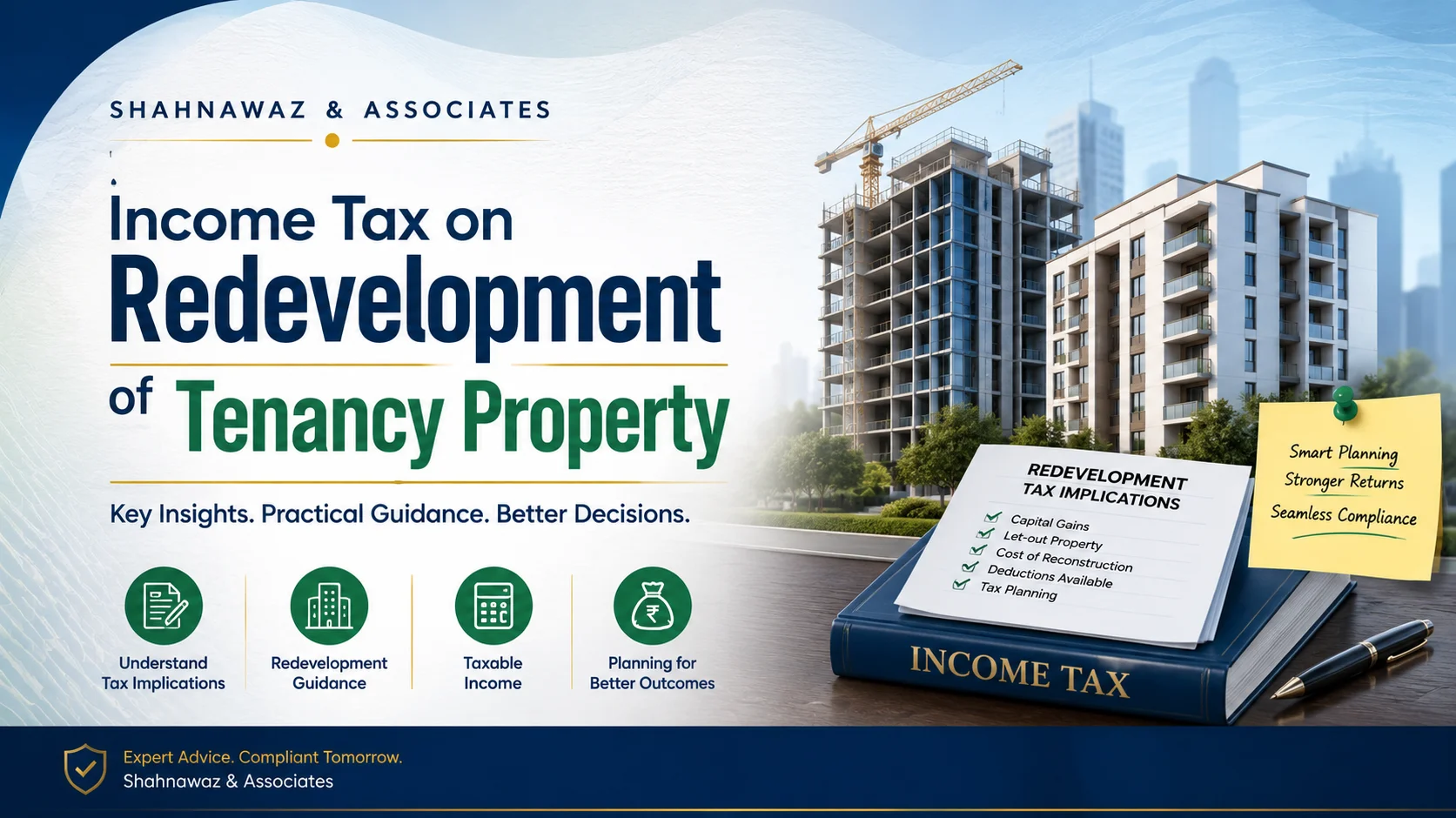
In metro cities like Mumbai, thousands of old properties—many over 50-60 years old—are undergoing redevelopment. Under the traditional pagdi system (also called "pagri"), existing tenants receive new residential flats in the redeveloped structure upon surrendering their tenancy rights to the landlord or developer.
This is not a simple exchange. From an income tax perspective, the relinquishment of your tenancy right is treated as a capital asset transfer, triggering capital gains tax. Many taxpayers wrongly assume the new flat they receive in exchange is tax-free.
Why This Article Matters
If you are surrendering tenancy rights in exchange for a new property in a redevelopment project, you must understand:
- How your tenancy right is valued for tax purposes
- What capital gain arises from the exchange
- Whether you qualify for exemption under Section 54F/86
- What conditions you must satisfy to claim this exemption
- What mistakes can disqualify you from exemption (and cost you 20% tax on gains)
The Pagdi System: Understanding Your Tenancy Right
The pagdi system originated in Maharashtra, Gujarat, and Delhi as an informal workaround during colonial tax regimes. Today, it's partially regulated under the Maharashtra Rent Control Act, 1999.
What is a "Pagdi"?
Under the pagdi system, a tenant pays a lump-sum amount (the "pagdi" or "premyum") to the landlord to acquire long-term occupancy rights. In exchange:
- The tenant gets possession and right to occupy the property
- The tenant pays nominal rent (much lower than market rates)
- The tenant can sell, gift, or transfer their pagdi rights to others
- The tenant does NOT own the property—only the right to occupy it
Why Redevelopment Changes Everything
In old buildings, landlords often want to redevelop. When this happens, tenants cannot be evicted under rent control. Instead, developers negotiate with tenants to surrender their tenancy rights in exchange for:
- A new flat in the redeveloped structure (usually higher size/quality)
- Sometimes, additional cash compensation
- Stamp duty/registration costs paid by developer
The catch: This exchange is not a tax-free gift. The new flat's value is considered "consideration received" for surrendering your tenancy right. This triggers capital gains calculation.
How Tenancy Relinquishment is Taxed: The Basics
Step 1: Is Your Tenancy Right a "Long-Term Capital Asset"?
According to Section 2(42A) of the Income Tax Act, a capital asset held for more than 2 years is a "long-term capital asset." Most pagdi tenancy rights in metro cities have been held for 20-50+ years. Therefore:
- ✅ Your tenancy right qualifies as a long-term capital asset
- ✅ Capital gain is taxed at 20% (plus applicable surcharge and cess)
- ✅ Cost Inflation Index (CII) adjustments apply to your cost of acquisition
Step 2: Calculate Capital Gain & Tax Rate
The formula under Section 45-48 is:
| Value of New Flat (FMV as per agreement) | = Consideration Received |
| MINUS: Cost of Acquisition (varies by acquisition date—see below) | = |
| Long-Term Capital Gain (LTCG) | Taxable (rate depends on acquisition date) |
🔴 Critical: Two Tax Rate Options (Effective July 23, 2024)
If Your Tenancy Right Was Acquired BEFORE July 23, 2024:
You have TWO OPTIONS—choose whichever results in LOWER tax:
- Option 1: 12.5% without Indexation Benefit
Tax = Capital Gain × 12.5%
No CII adjustment allowed
Example: ₹40L gain = ₹5L tax - Option 2: 20% WITH Indexation Benefit
Tax = Indexed Capital Gain × 20%
Cost of acquisition adjusted for inflation using CII
Example: ₹40L gain becomes ₹20L after indexation = ₹4L tax
If Your Tenancy Right Was Acquired ON OR AFTER July 23, 2024:
Only one option applies: 12.5% tax WITHOUT indexation benefit. No choice.
What This Means for Your Calculation:
| Your Scenario | Tax Rate | Indexation Benefit? |
|---|---|---|
| Old pagdi right (acquired pre-2024) + new flat in 2025 | Choose: 12.5% OR 20% | Only in 20% option |
| Redevelopment deal closing in 2026 (pagdi held since 1990s) | Choose: 12.5% OR 20% | Only in 20% option |
| Hypothetical: Acquired pagdi AFTER July 23, 2024 (rare) | Fixed: 12.5% only | No benefit available |
Step 3: Can You Claim Exemption?
Here's where many tenants get it wrong. The new flat you receive is NOT automatically tax-free. However, you can claim exemption if you satisfy conditions of Section 54F (old law) or Section 86 (new law).
Old vs. New Law: Important Note
- For Income earned 1 April 2025 to 31 March 2026: Use old Section 54F (Income Tax Act, 1961)
- For Income earned from 1 April 2026 onward: Use new Section 86 (Income Tax Act, 2025)
Both sections have nearly identical conditions. This guide covers both.
Four Conditions to Claim Section 54F/86 Exemption
To claim zero tax on your tenancy relinquishment gain, you must satisfy ALL of the following conditions. Missing even one disqualifies you from the entire exemption.
Condition 1:
Not Own More Than 2 Properties
On the date of tenancy surrender, you cannot hold more than one other residential property
Condition 2:
3-Year Construction Completion
The new residential house must be completed within 3 years of tenancy relinquishment date
Condition 3:
Full Investment in One Property
Entire net consideration must be invested in one residential house in India
Condition 4:
Time of Purchase/Construction
Purchase within 1 year BEFORE or 2 years AFTER relinquishment date; construction within 3 years AFTER
Types of Compensation in Redevelopment: Tax Treatment
In most redevelopment deals, you don't receive ONLY a new flat. Builders often provide additional payments for various reasons. Understanding the tax treatment of each type is crucial to your planning.
The Three Types of Compensation & Their Tax Status
🟢 TYPE 1: Hardship/Rehabilitation/Shifting Allowance (TAX-EXEMPT)
What it covers: Compensation for inconvenience, temporary accommodation during construction, shifting costs, emotional hardship from displacement.
Tax Status: EXEMPT – Treated as a capital receipt (not income from other sources, not capital gains), therefore NOT taxable.
Landmark Ruling: ITAT Mumbai (Ajay Parasmal Kothari case) held that compensation received for hardship, rehabilitation, and shifting expenses during redevelopment is in the nature of capital receipt and not assessable to tax—whether or not the tenant actually used the compensation for alternate accommodation.
Examples of Hardship Compensation:
- ₹2L "inconvenience allowance" paid in lump sum
- Monthly rent compensation of ₹5,000/month for 24 months (₹1.2L total)
- ₹50,000 shifting and brokerage allowance
- Temporary accommodation cost during construction
🟡 TYPE 2: Additional Cash/Compensation for Surrender (TAXABLE as Capital Gain)
What it covers: Cash compensation specifically for surrendering your tenancy right, especially if the new flat's value doesn't fully compensate you for the right you're giving up.
Tax Status: TAXABLE – Treated as "consideration received" for transfer of your tenancy right capital asset. Adds to the capital gain liability.
Example Scenario:
- Your old tenancy right = valued at ₹50L
- Builder gives you: New flat (FMV ₹75L) + ₹10L cash
- Classification: New flat (₹75L) = investment for Section 54F; Cash (₹10L) = additional consideration
Tax Calculation:
- Total consideration received = ₹75L (flat) + ₹10L (cash) = ₹85L
- Cost of acquisition = ₹50L
- Capital gain = ₹85L – ₹50L = ₹35L
- Investment in new flat = ₹75L (proportional exemption only)
- Taxable gain = ₹35L × (₹10L / ₹85L) = ₹4.1L @ 12.5% OR 20% = ₹0.51L to ₹0.82L tax
🟠 TYPE 3: Corpus Fund / Common Area Maintenance Fund (TAX-EXEMPT)
What it covers: Contributions from flat owners for future maintenance, elevators, common area construction, long-term sinking fund in the redeveloped building.
Tax Status: EXEMPT – Capital receipt (not related to capital gains from transfer).
Why Exempt: You're not "selling" this as part of surrendering tenancy. It's a separate contribution for building maintenance.
How to Handle Mixed Payments: Strategic Planning
Scenario 1: Can I Invest Additional Cash in Section 54F to Get Full Exemption?
Question: Builder gives ₹75L flat + ₹10L cash. Can I invest the ₹10L cash in another residential property to qualify for full Section 54F exemption?
Answer: We recommend to get additional area insted of amount because to get the benefit of 54F you need to invest it in new property and claiming two property under 54F is subject to litigation:
Scenario 2: What If I Can't Invest the Cash in Another Property?
If you only invest ₹75L in the main flat and don't invest the ₹10L cash elsewhere:
- Proportionate exemption applies = (₹75L / ₹85L) × ₹35L = ₹30.88L exempt
- Taxable portion = (₹10L / ₹85L) × ₹35L = ₹4.1L @ 12.5% to 20% = ₹0.51L to ₹0.82L tax
Alternatively, deposit the ₹10L in Capital Gains Account Scheme (CGAS) by your ITR filing date and invest it within 3 years for Section 54F exemption later. This is more complex but legally valid.
Consultation Point: Labeling Matters!
This is CRITICAL: The difference between "hardship compensation" (tax-free) and "additional consideration for surrender" (taxable) is often in how the agreement LABELS it. Before signing:
- Negotiate with builder to specifically label non-flat payments as "hardship," "shifting," "rehabilitation," or "rent compensation"
- Get separate line items in the agreement for each type
- If builder bundles everything, ask for detailed breakup
- Consult your tax advisor on labeling BEFORE signing
Condition 1: The "Two Properties" Rule Explained (In Depth)
The Core Rule
On the date you surrender your tenancy right, you must not own more than one residential property other than the new property you are acquiring.
What Does "Own" Mean?
- Legal ownership in your name: Property where your name is in the title deed or registration
- Includes joint ownership: If you co-own with spouse or others, it counts
- Includes self-occupied and let-out properties: Both types count
- Date that matters: The date you relinquish tenancy rights (not the date you get the new flat)
Analysis:
- Bandra flat = 1 residential property (counts)
- Lonavala plot (joint) = typically NOT considered "owned" by you alone; depends on whether it's co-owned or not. See detailed section below.
- Commercial shop = does NOT count (not residential)
Likely Outcome: If the plot is co-owned with your wife, you likely CAN claim exemption. But this is litigious and the IT Department will challenge you initially. You'll need to defend it at ITAT.
What Does NOT Count as "Residential Property"?
- Commercial properties (shops, offices, warehouses)
- Industrial properties
- Agricultural land
- Vacant plots (even if zoned residential)
- Properties in spouse's sole name (if you file separately)
- Property held in trust where you're not the beneficiary
Deep Dive: Joint Ownership & Section 54F Exemption (Highly Litigious Area)
The Legal Debate: What Does "Owns" Mean?
Section 54F uses the word "owns" but does NOT define it. This has created a battleground between taxpayers and the IT Department:
- IT Department's Position: If your name appears on the title deed, even jointly, you "own" the property. Therefore, co-ownership counts toward the limit of 1 other residential property.
- Taxpayer's Position: Co-ownership is not "absolute ownership." If you own a property jointly with your spouse, you own only your SHARE (e.g., 50%), not the whole property. Therefore, the "two properties" rule shouldn't apply with the same harshness.
- Courts' Position: Split. Some high courts have supported the taxpayer's position; some have supported the IT Department's position.
🏆 Pro-Taxpayer Case Law (You Can Win With Litigation)
The Court observed that when assessing "ownership," the status of the assessee as an INDIVIDUAL must be considered. If the assessee owns a property jointly (meaning she owns only her share as an individual, not absolute ownership of the entire property), the exemption should be allowed.
🔴 IT Department's Counter-Position (Initial Rejection Likely)
Despite the pro-taxpayer case law, the IT Department typically:
- Denies the exemption at the assessment stage
- Argues that any property with the assessee's name (joint or sole) counts as "owned"
- Forces the taxpayer to appeal to CIT(A) and ITAT
💡 CRITICAL INSIGHT: Litigation Risk vs. Odds of Winning
Odds of Winning at ITAT: HIGH (60-70% based on pro-taxpayer precedents like J. Joshi case)
BUT:
- You WILL face initial rejection by the Assessing Officer
- You WILL need to hire a CA to represent you at CIT(A) and ITAT (₹20K-50K fees)
- The process takes 2-4 years (CIT(A) 6-12 months + ITAT 12-24 months)
- If your capital gain is ₹30L and tax at 20% is ₹6L, litigation might cost ₹50K but could save ₹6L. Worth it numerically. But emotionally draining.
The Dilemma: While you have a strong legal basis to claim exemption with co-owned property, the IT Department will fight you initially, and you'll need litigation to secure it. This is not a simple "accept it" claim.
Scenario-by-Scenario Analysis
1 Property Solely in Your Name
Exemption Claim: ✅ Safe & Defensible. No dispute with IT Dept.
You can own 1 residential property. You're eligible for Section 54F exemption.
1 Property Jointly with Spouse
Exemption Claim: ⚠️ Defensible but LITIGATION REQUIRED.
IT Dept will reject initially. You'll need CIT(A)/ITAT appeal. High odds of winning but costs time and money.
2+ Properties (Sole or Joint)
Exemption Claim: ❌ Indefensible. Exemption LOST.
Even with the most aggressive interpretation, courts won't allow exemption if you own 2+ residential properties combined (sole + joint).
1 Residential + 1 Commercial
Exemption Claim: ✅ Safe & Defensible. No dispute.
Commercial properties don't count. You can own 1 residential + unlimited commercial properties.
The "Three Co-Owned Properties" Scenario (Worst Case)
Real Scenario: You own residential properties in these configurations:
- Flat A: Jointly owned with wife
- Flat B: Jointly owned with wife
- Flat C: Jointly owned with wife
Question: Can you claim exemption if co-ownership doesn't count as "ownership"?
Answer : While there is a highly defensible legal basis to claim the exemption based on the argument that co-ownership does not equal absolute ownership, attempting to do so with three co-owned properties is a GUARANTEED TRIGGER FOR LITIGATION.
What Will Happen:
- ✅ Defensibility: Your legal argument is sound (based on J. Joshi case)
- ❌ Initial Assessment: IT Department will reject the exemption claim categorically
- ✅ Appeals: You have a strong case at CIT(A) and ITAT (pro-taxpayer precedents exist)
- ⏱️ Timeline: 3-4 years of litigation
- 💰 Cost: ₹50K-1L in CA/legal fees, plus your stress
- 📊 Odds of Winning at ITAT: 60-70% based on case law
- Consult with a tax specialist on joint ownership interpretation
- Consider removing your name from co-owned properties (gift to spouse) to reduce count
- Time the redevelopment relinquishment after you've de-registered from some jointly held properties
- Only then proceed—this eliminates litigation risk
Cost-Benefit: Spending ₹10K on pre-consultation now can save ₹50K+ in litigation later AND guarantee exemption without fight.
Practical Difficulties & Common Traps
🔴 Trap 1: Inherited Property
Scenario: Your father passed away, and his flat in your ancestral home is in the process of being transferred to you. It's not yet registered in your name, but you have a will or succession certificate. Does it count as "owned"?
Answer: Tax Department may argue that if you have legal claim (will/succession), it counts. Safest approach: complete the registration BEFORE you surrender tenancy rights. This removes ambiguity.
🔴 Trap 2: Spouse's Property
Scenario: Your wife owns a flat in her name in Mumbai. You file ITR separately. You're claiming exemption for the relinquishment. Does your wife's property count against your limit of 2 properties?
Answer: For ITR purposes, if you file separately, only properties in YOUR name count. If you file jointly as HUF (Hindu Undivided Family), all family properties count. This is where proper advice matters—choosing filing status can affect your exemption eligibility.
🔴 Trap 3: Recently Purchased Property
Scenario: You purchased a second residential flat 2 months ago (pending registration). You are now surrendering your pagdi. Does the new purchase disqualify you?
Answer: Yes. The date is when you relinquish pagdi. If you already own 2 properties (even if registration is pending), the exemption is lost. This is why timing and sequencing of transactions is critical.
The 2025 Act Change (Section 86)
Under Section 86(5) of the new 2025 Act, there's an important anti-speculation clause: If you purchase OR construct any other residential property within 2 years after relinquishment (separate from the new property you're claiming exemption for), the exemption is withdrawn. This means:
- You relinquish pagdi on 1 June 2025
- You receive new flat on 15 June 2025 (registration done)
- You cannot buy or build another residential property until 15 June 2027
- If you violate this, your entire capital gain becomes taxable at 20%/ 12.5%
Condition 2: The Critical 3-Year Construction Completion Requirement
The Core Rule (What the Law Says)
The new residential house must be "constructed" within 3 years from the date of tenancy relinquishment. This is not a recommendation—it's a strict legal requirement.
However, in redevelopment scenarios, there's a critical difference: The developer is constructing the building. You are not. So the "completion" date is when the building is completed and you receive possession/registration, not when all occupants move in.
What "Completed Construction" Means
- Structural completion: Walls, roof, and basic structure finished
- Habitable condition: Electricity, water, sanitation working
- Registration: New property registered in your name (critical for redevelopment cases)
- Occupancy certificate (OC): BMC/Municipal approval that building is fit for habitation
Important Case Law on 3-Year Deadline
Learning: In redevelopment projects, the key is NOT "100% completion." It's whether the property is in a "habitable and livable condition" within 3 years. This gives some flexibility, but it's still risky to rely on this—better to complete well within the deadline.
Practical Difficulties in Redevelopment Scenarios
🔴 Difficulty 1: Developer Delays Construction
Real Scenario: Builder promises completion in 2.5 years but delays due to labor shortages, material issues, or structural problems. Construction drags on to 3.5 years. By the time you get possession, the 3-year clock has expired.
Your Risk: You lose the exemption. The entire capital gain (say ₹50 lakh) becomes taxable at 20% = ₹10 lakh tax liability. Plus interest and penalties if IT department notices.
Protection: Before signing the redevelopment agreement, negotiate a completion guarantee with penalty clause. Document the exact date you relinquish tenancy rights. If delayed, get the developer to compensate for lost tax exemption or delay registration to the 3-year mark.
🔴 Difficulty 2: Ambiguity on "Completion Date"
Real Scenario: Building structure is complete (walls, roof), but final paintwork, fittings, and common area finishing are pending. Is this "completion"? Developer says yes. IT officer says no.
Answer (per case law): As long as the residential unit is "habitable"—meaning occupancy cert obtained, electricity/water working—it counts as completed, even if some finishing work remains.
Protection: Get a formal "Completion Certificate" from the builder and municipal authority (BMC in Mumbai). Ensure your property registration is COMPLETED within the 3-year window. Do not wait for final possession delivery if registration can be done earlier.
🔴 Difficulty 3: Your Role in Construction Timeline
Real Scenario: Building is completed by month 30. But you delay taking possession/registration because you're working abroad and won't move in for 5 more years. Does the 3-year deadline apply to when you physically occupy or when the property is available for possession?
Answer: The law says "constructed within 3 years." It does NOT say "occupied within 3 years." So if the building is completed/registered in your name by month 36, you satisfy the condition—even if you don't physically move in for years.
Best Practice: Complete registration within 3 years, even if you don't occupy. This secures your exemption.
🔴 Difficulty 4: Multiple Properties in Same Redevelopment
Real Scenario: You own 2 adjacent flats under pagdi system in the same old building. Both get surrendered and redeveloped. You receive 2 new flats. Can you claim Section 54F exemption for both properties?
Answer: No. Section 54F/86 allows exemption for investment in "one residential house." Multiple properties do not qualify. You can claim exemption on only one property (the one with larger gain). The other becomes taxable.
Planning: Consult before you agree to surrender both pagdi rights. You might negotiate with the developer to receive one flat and cash compensation instead, then structure the transaction differently.
Timeline Checklist for 3-Year Completion
| Day/Month | Event | Must Do |
|---|---|---|
| Day 0 | You relinquish tenancy rights to builder | Document this date precisely (letter from builder, deed) |
| Days 1-1095 | Construction ongoing by builder | Monitor progress; ensure no unexplained delays |
| By Day 1095 (Month 36) | Completion + Registration | Ensure property is registered in your name by this date |
| Post Day 1095 | File ITR claiming exemption | Attach completion certificate, registration proof, builder letters |
Condition 3: Full Investment in One Property (Proportionality Rule)
The Core Rule
The exemption is proportionate to your investment. Here's how:
| If | Then |
|---|---|
| Net consideration = ₹50L (sale proceeds of pagdi) You invest ₹50L+ in new flat | 100% exemption – zero tax on capital gain |
| Net consideration = ₹50L You invest only ₹30L in new flat | Proportionate exemption – 60% of capital gain exempt, 40% taxable at 20% |
| Net consideration = ₹50L You invest ₹0 (receive cash instead) | No exemption – 100% capital gain taxable at 20% |
What Counts as "Investment"?
- Purchase price of new flat: The value for which you take ownership
- Construction cost: If you build a new house (not typical in redevelopment)
- Registration/Stamp duty: Paid for acquiring the property (counts toward investment)
- Value credited by developer: If developer values your new flat at ₹60L in the agreement, this counts as your "investment"
What Does NOT Count?
- Cash compensation paid by builder (separate from flat value)
- Plot given as additional benefit
- Parking space (unless it's considered "residential house"—unlikely)
- Shop or commercial unit in the same building
Critical Scenario: What If You Have NO Proof of Original Tenancy Cost?
What This Means: If you bought your tenancy right 30 years ago but have lost all proof of cost:
- Cost of Acquisition = ₹0 (by deeming under Section 55(2)(a))
- Capital Gain = Entire consideration received (the new flat's value)
- You pay full tax on the entire amount—no exemption from Section 54F unless invested
- You surrendered pagdi (cost not provable, therefore ₹0)
- New flat received = ₹60L (fair value)
- Capital gain = ₹60L – ₹0 = ₹60L (FULL AMOUNT)
- If you invest ₹60L in the new flat = 100% exemption under Section 54F
- If you invest only ₹50L = proportionate exemption only
The Silver Lining: Because the capital gain is the ENTIRE consideration (₹60L), and you're investing that same amount (₹60L) in the new flat, Section 54F exemption covers the entire gain. You end up paying ₹0 tax anyway.
However, if cost is determinable (you have old purchase deeds), it REDUCES the capital gain and your tax burden. Always maintain and produce documentation of your original tenancy acquisition cost.
Redevelopment-Specific Scenario
Calculation:
- Capital gain = ₹60L (fair value of new flat) + ₹10L (cash) – ₹50L (cost of tenancy right) = ₹20L
- Investment in new flat = ₹60L (the flat's purchase price)
- Net consideration = ₹70L (flat + cash)
- Exemption = (₹60L / ₹70L) × ₹20L = ₹17.14L exempt
- Taxable = (₹10L / ₹70L) × ₹20L = ₹2.86L @ 12.5% = ₹0.36L tax
Capital Gains Cap (Important: ₹10 Crore Limit)
From April 1, 2023, there's a crucial cap: Section 54F/86 exemption is limited to ₹10 crore of capital gains.
- If capital gain is ₹8 crore (within limit) → full exemption possible
- If capital gain is ₹12 crore (exceeds limit) → exemption only on ₹10 crore; remaining ₹2 crore taxable at 20%
In redevelopment cases in metro cities, this limit is rarely exceeded. But for high-value properties or multiple surrenders, it can matter.
Frequently Asked Questions: 25 Real-Life Scenarios
Based on actual cases and queries from taxpayers in redevelopment projects, here are practical examples to test your understanding:
Why Consultation BEFORE Signing the Agreement is Critical
The High-Risk Moment
Most redevelopment negotiations happen quickly. Builders pressure tenants to sign agreements within days. Tenants often don't consult tax advisors until after signing—and by then, it's too late.
What Should You Consult On (Before Signing)?
1. Your Current Property Holdings
- List all residential properties you own (self, spouse, joint)
- Verify if any are in ancestral/inherited status
- Check if any are pending registration (count as "owned")
- Determine if any need to be sold before relinquishing pagdi
2. The Relinquishment Date & Timeline
- Negotiate with builder to fix exact relinquishment date in writing
- Understand the 3-year clock starts from this date
- Verify builder's construction schedule (get it in writing)
- Include penalties if builder delays beyond 3 years
3. The New Property's Valuation
- Ensure the agreement clearly states the flat's fair market value
- This value = "consideration received" for capital gains calculation
- Get independent valuation (Ready Reckoner rate) to verify fairness
- If builder offers cash + flat, separate the cash (not part of "investment")
4. Your Cost of Acquisition of Old Pagdi Right
- Gather old purchase deeds, payment receipts, agreements
- If records are lost, get affidavits or builder letters confirming your payment
- If property is very old (pre-1980), value as on 1 April 2001 is alternative
- Lower cost = lower capital gain = lower tax
5. Registration & Compliance Timelines
- Ensure redevelopment agreement specifies: "Registration must be completed within 3 years"
- Do not rely on builder's promise; get it in writing
- Plan for potential stamp duty, registration fees
- Understand who (builder/tenant) bears these costs
6. Filing Status & ITR Strategy
- Should you file separately or as HUF?
- Should you and spouse coordinate property ownership?
- Do you need to amend past ITRs?
- What ITR form is suitable for your situation?
Red Flags: When You MUST Consult (Even If It Seems Trivial)
- 🚩 You own or are planning to buy another residential property
- 🚩 The relinquishment agreement doesn't specify the flat's valuation clearly
- 🚩 Builder offers choice of flat or cash (need guidance on which)
- 🚩 You inherited or are inheriting other properties
- 🚩 Your spouse owns properties; you're unsure if they count against your limit
- 🚩 You have no records of your original pagdi cost (or cost is very low)
- 🚩 Builder's construction timeline seems unrealistic (>3 years)
- 🚩 You're an NRI or have foreign income
- 🚩 You plan to buy/build another property within 2 years after this relinquishment
What to Bring to Your Consultation
- Draft redevelopment agreement from builder
- Old pagdi purchase deed or any proof of original cost
- List of all properties you own (with approximate values)
- Spouse's property details (if applicable)
- Last 2 ITRs filed (to understand filing history)
- Any correspondence with IT Department (if previously assessed)
- Preliminary valuation of new flat (from builder, Ready Reckoner, or property dealer)
Timeline for Consultation
| Phase | Action | Timeline |
|---|---|---|
| Phase 1: Exploration | Builder approaches for redevelopment; preliminary discussion | Months 1-2 (before any agreement) |
| Phase 2: Consultation | Meet CA with draft agreement; get tax advice | Month 2-3 (before signing) |
| Phase 3: Negotiation | Based on tax advice, negotiate terms with builder | Month 3-4 |
| Phase 4: Finalization | Sign agreement with tax-optimized terms | Month 4-5 |
| Phase 5: Execution & Monitoring | Track relinquishment date, construction progress, registration | Year 1-3 (post-signing) |
| Phase 6: ITR Filing | File ITR claiming Section 54F/86 exemption with documents | Year 4 (after completion) |
Conclusion: Your Path to Zero Tax on Pagdi Relinquishment
Surrendering your tenancy right in a redevelopment project can result in a significant capital gain. However, with proper planning, you can make this entire gain tax-free under Section 54F (old law) or Section 86 (new law).
The four conditions are:
- Not own more than one residential property (on relinquishment date)
- Complete the new house within 3 years (strictly enforced)
- Invest the entire proceeds in one residential property (proportional exemption otherwise)
- Register the new property in your name within the timeline (possession is secondary)
The difference between informed and uninformed taxpayers in redevelopment deals is often ₹5L to ₹20L in tax savings. That's not a small number.
Your Next Step
If you are considering a redevelopment agreement or have already signed one, don't delay:
We specialize in property taxation, redevelopment transactions, and Section 54F/86 exemption planning. Our team will:
- Review your agreement and property status
- Calculate your capital gain accurately
- Identify any tax pitfalls and recommend solutions
- Ensure your ITR filing is compliant and optimized
- Represent you before IT Department, if needed
One consultation now can save you 5 figures in tax.