Tax Audit Applicability in India: Complete Guide for Individuals, Firms, LLPs, Companies, Trusts, Societies & Section 8 Companies
Who needs a tax audit, who doesn't, and exactly where the threshold lies — mapped clause-by-clause across the Income Tax Act, 1961 and the new Income Tax Act, 2025.
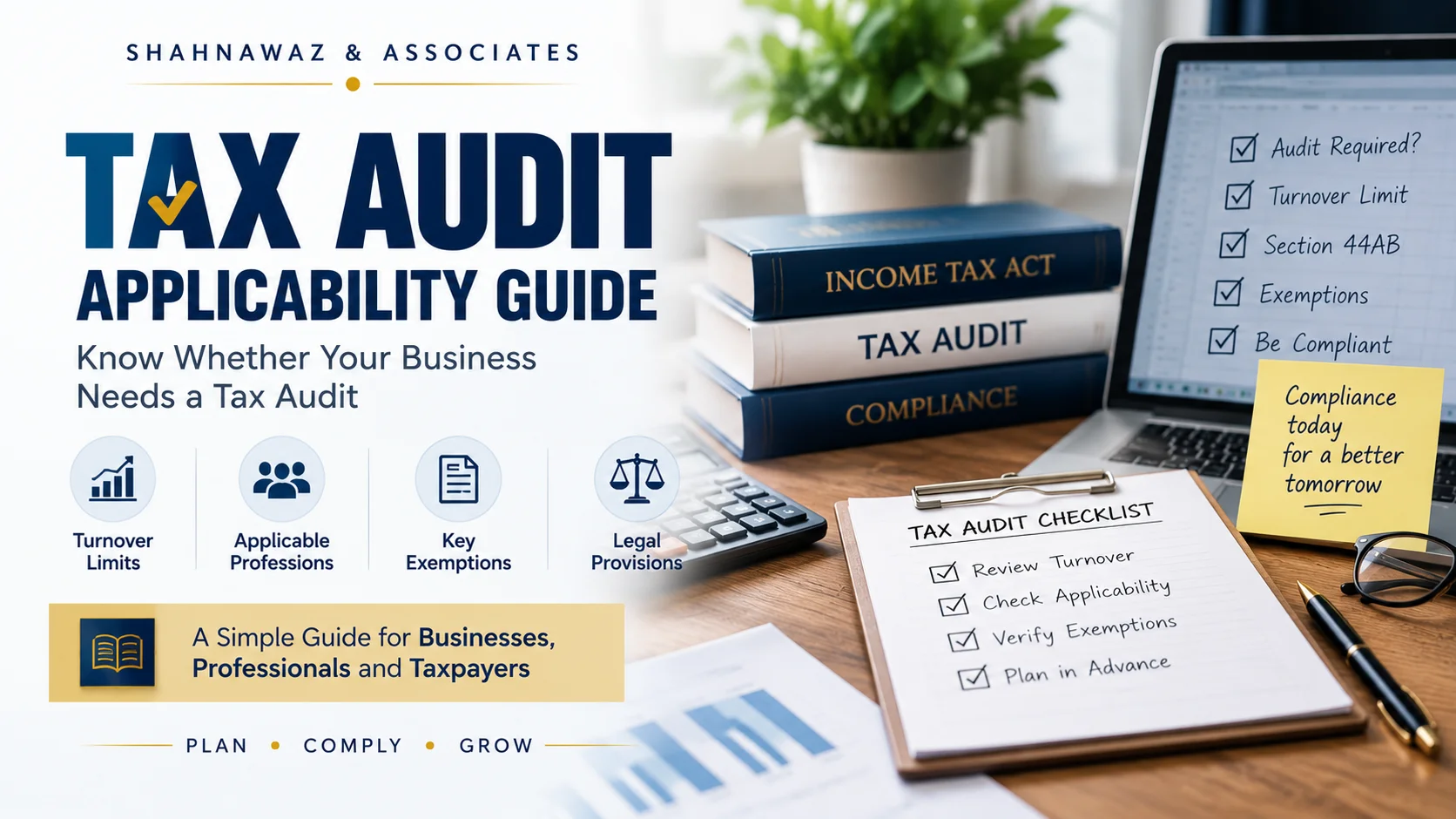
Every year, thousands of individuals, shopkeepers, professionals, partnership firms, LLPs, private and public companies, charitable trusts, societies and NGOs across Mumbai and India ask the same question in different words: "Do I need a tax audit this year, or not?" The confusion is genuine — the rules differ by the type of entity, the nature of income, the turnover slab, and now, with the new Income Tax Act, 2025 renumbering almost every familiar section, even seasoned taxpayers are second-guessing themselves.
This guide untangles all of it in one place — entity by entity, threshold by threshold, old section versus new section — so you know exactly where you stand before the 30th September deadline arrives. If you would rather hand this over to a professional altogether, our Tax Audit & Statutory Audit Services team handles the entire process end to end.
⚡ Quick Answer: Who Needs a Tax Audit?
- Business: Tax audit is mandatory once turnover crosses ₹1 crore (raised to ₹10 crore if cash transactions are 5% or less of total transactions).
- Profession: Tax audit is mandatory once gross receipts cross ₹50 lakh (raised to ₹75 lakh under the same 5% cash-transaction condition).
- Presumptive taxpayers (44AD/44ADA/44AE): Audit is triggered if you declare profit below the presumptive rate and your total income exceeds the basic exemption limit.
- Companies (Pvt Ltd, Public Ltd, OPC, Section 8): A statutory audit under the Companies Act, 2013 is compulsory for every company, in every year, irrespective of turnover or profit.
- Trusts, NGOs & Societies (registered u/s 12AB): Audit is mandatory if income before claiming exemption exceeds the basic exemption limit (₹2.5 lakh).
- Salaried individuals with no business/profession: Tax audit does not apply to you at all — regardless of how large your salary, capital gains or house-property income is.
1What Is a Tax Audit & Why It Exists
A tax audit is an independent examination of an assessee's books of account by a practising Chartered Accountant, aimed at verifying that income, deductions, and compliances (TDS, cash payment limits, loan acceptances, etc.) have been correctly reported to the tax department. It is distinct from a statutory audit under the Companies Act and from a GST audit — a single taxpayer can be subject to more than one of these simultaneously.
Old Law Income Tax Act, 1961
Governed by Section 44AB. Report filed in Form 3CA/3CB along with the particulars in Form 3CD. This is what applies for FY 2025-26 (AY 2026-27), since that year is still assessed entirely under the 1961 Act.
New Law Income Tax Act, 2025
The corresponding provision is renumbered as Section 63, operative from Tax Year 2026-27 onward (i.e., income earned on or after 1 April 2026). The three current forms will eventually be consolidated into a single Form No. 26.
💡 Practitioner's Note
The Income Tax Act, 2025 is not a policy overhaul for tax audit — the government has confirmed the turnover thresholds, the digital-transaction relief, and the presumptive taxation rates all carry forward unchanged. What has changed is purely the section numbering and drafting style (over 800 sections in the 1961 Act have been consolidated into 536 sections in the 2025 Act). Our firm tracks both numbering systems side by side for every client engagement — see our Tax Guides for the running series on this transition.
2Individuals & HUF
Tax audit applicability for an individual or a Hindu Undivided Family depends entirely on whether they carry on a business or a profession — it has nothing to do with salary, rental income, or capital gains.
| Category | Threshold (Old Act Sec. 44AB) | Threshold (New Act Sec. 63) | Audit Required When |
|---|---|---|---|
| Business (regular) | Turnover > ₹1 crore | Turnover > ₹1 crore | Always — unless the 95% digital-transaction relief applies (see Section 11 below) |
| Business (95%+ digital receipts & payments) | Turnover > ₹10 crore | Turnover > ₹10 crore | Cash receipts and cash payments must each independently be ≤5% of the total |
| Profession (regular) | Gross receipts > ₹50 lakh | Gross receipts > ₹50 lakh | Doctors, lawyers, CAs, architects, engineers, and other Sec. 44AA specified professions |
| Profession (95%+ digital receipts) | Gross receipts > ₹75 lakh | Gross receipts > ₹75 lakh | Same 5% cash-transaction condition applies |
| Salary / House Property / Capital Gains / Other Sources only | Not applicable | Not applicable | Tax audit never applies — irrespective of income size |
✔ Good to Know
Nearly every case of "I earn ₹80 lakh in salary, do I need an audit?" has the same answer — no. Tax audit is a business/profession-specific compliance, not a wealth or total-income test. If you're unsure how your specific income streams are classified, our ITR Filing service team can review this for you before the filing deadline.
3Partnership Firms
A partnership firm (registered or unregistered, but excluding an LLP) is tested for tax audit exactly like an individual carrying on business or profession — ₹1 crore / ₹10 crore for business, ₹50 lakh / ₹75 lakh for a professional firm (e.g., a CA firm, law firm, or architecture firm). There is no separate statutory audit requirement for a partnership firm under the Indian Partnership Act, 1932 — the only audit trigger is the Income Tax Act itself (and GST, if applicable).
⚠ The Firm-Specific Trap Most People Miss
A firm has no basic exemption slab — its very first rupee of taxable income is chargeable to tax. This matters enormously for the presumptive-taxation audit trigger discussed in Section 9 below: if a firm opts out of Section 44AD/58 and declares profit lower than the presumptive rate, the audit is effectively mandatory in almost every case, because the "total income exceeds the basic exemption limit" condition is satisfied the moment the firm has any positive income at all.
Read our detailed guide on Partnership Firm Registration in Maharashtra if you're setting up a new firm and want to plan your compliance calendar from day one.
4Limited Liability Partnerships (LLP)
LLPs sit at the intersection of two separate audit regimes:
🏛 Under the LLP Act, 2008
A financial statement audit is mandatory only if annual turnover exceeds ₹40 lakh or capital contribution exceeds ₹25 lakh (LLP Rules 2009, Rule 24). Below both limits, the LLP may self-certify its accounts.
📋 Under the Income Tax Act
Section 44AB/63 applies with the same ₹1 crore / ₹10 crore (business) and ₹50 lakh / ₹75 lakh (profession) thresholds as a firm. Note: LLPs are excluded from the presumptive taxation schemes (44AD and 44ADA / new Sec. 58), so they must always maintain regular books once they cross the basic bookkeeping threshold.
This means an LLP can easily be required to get two separate audits in the same year — one under the LLP Act and one under the Income Tax Act — once turnover crosses ₹1 crore. See our LLP Annual Compliance service for a consolidated filing calendar.
5Companies – Private Limited, Public Limited & OPC
This is where the most common misconception lies: a company's statutory audit has no turnover exemption at all.
⚠ Zero-Turnover Companies Are Not Exempt
Under Section 139 of the Companies Act, 2013, every private limited company, public limited company, and One Person Company (OPC) must appoint a statutory auditor and get its accounts audited every single year — even a dormant company with ₹0 turnover and no transactions. There is no "small company" or "startup" carve-out from the audit itself (small companies only get relief from auditor rotation and a few disclosure requirements, not from the audit).
| Audit Type | Governing Law | Threshold | Applies To |
|---|---|---|---|
| Statutory Audit | Companies Act, 2013, Sec. 139 | None – always mandatory | Every Pvt Ltd, Public Ltd & OPC, regardless of turnover or profit |
| Tax Audit | Income Tax Act Sec. 44AB (New Act Sec. 63) | Turnover > ₹1 crore / ₹10 crore | Only if turnover crosses the threshold; if it doesn't, only the statutory audit is needed and Form 3CA/3CD is not filed |
In practice, since Form 3CA (rather than 3CB) is used precisely because the company is already audited under the Companies Act, most CAs conduct both audits together as a single engagement once the tax-audit threshold is crossed. For registration and structuring queries, see our Public Limited Company and Startup / Company Registration pages.
6Section 8 Companies (Non-Profit Companies)
A Section 8 company is incorporated under the Companies Act for charitable, social, or promotional objects — but it is still a company in every legal sense. This gives it a potentially three-layer audit exposure, which is one of the most under-discussed areas in compliance:
- Companies Act statutory audit – mandatory every year, exactly like any Pvt Ltd or Public Ltd company, irrespective of turnover.
- Trust-style income tax audit – if the Section 8 company is separately registered under Section 12AB (Income Tax Act, 2025: Section 332) to claim exemption on its surplus, then the same audit trigger that applies to trusts and societies (see Section 7 below) kicks in — audit required once income before exemption exceeds the basic exemption limit.
- Regular Sec. 44AB/63 tax audit – if the Section 8 company also runs an incidental business activity whose turnover crosses ₹1 crore / ₹10 crore, the standard business-audit threshold applies on top of the above two.
Most Section 8 companies never trigger layer 3, but layers 1 and 2 are compulsory for almost all of them. Explore our Section 8 Company Registration service and our 12A / 80G Registration guide to understand the full compliance stack before incorporation.
7Trusts, Societies & Registered NGOs
Charitable and religious trusts, societies, and other non-profit organisations registered under Section 12AB (or approved under Section 10(23C)) are governed by a completely separate audit trigger from Section 44AB.
| Condition | Old Act Reference | New Act Reference | Consequence |
|---|---|---|---|
| Total income (before exemption u/s 11 & 12) exceeds the basic exemption limit (currently ₹2.5 lakh) | Sec. 12A(1)(b) | Sec. 347–349 | Books must be audited by a CA; audit report filed in Form 10B or 10BB |
| Total income before exemption exceeds ₹5 crore, OR foreign contribution received, OR income applied outside India | Rule 16CC / 17B | Corresponding rule (Income-tax Rules, 2026) | Form 10B is required |
| None of the above three conditions apply | Rule 16CC / 17B | Corresponding rule | Form 10BB is sufficient |
| Registration itself (12A/12AA → 12AB) | Sec. 12AB | Sec. 332 | Determines eligibility to claim exemption at all |
⚠ Missing the Audit = Losing the Exemption
Unlike a business, where a missed audit only attracts a penalty, a trust or NGO that fails to get its accounts audited (when required) or files the wrong form (10B instead of 10BB, or vice-versa) risks losing the entire Section 11/12 exemption for the year — the whole surplus then becomes taxable at the maximum marginal rate. Both forms must be filed at least one month before the ITR-7 due date.
We've written a dedicated, trustee-friendly walkthrough of this exact process — read ITR-7 Explained Simply: A Trustee's Guide to Filing, Form 10B/10BB & 80G Matching for the full mechanics, or reach out via our Audit Services page to get your trust's Form 10B/10BB filed correctly this year.
8AOP, BOI & Co-operative Societies
👥 Association of Persons (AOP) / Body of Individuals (BOI)
Not eligible for presumptive taxation (44AD/44ADA are available only to individuals, HUFs, and partnership firms other than LLPs). An AOP/BOI carrying on business or profession is tested purely on the standard Sec. 44AB/63 turnover thresholds — ₹1 crore/₹10 crore or ₹50 lakh/₹75 lakh, as applicable.
🏢 Co-operative Societies
Mandatory annual audit under the applicable State (or Multi-State) Co-operative Societies Act by a panel auditor — irrespective of turnover. In addition, a Sec. 44AB/63 income tax audit applies separately if the society's business turnover (including transactions with non-members) crosses the ₹1 crore/₹10 crore threshold. Deduction under Sec. 80P may also be relevant depending on the category of society.
9Presumptive Taxation & the Audit Trap
Sections 44AD, 44ADA, and 44AE of the 1961 Act — consolidated into a single Section 58 under the Income Tax Act, 2025 — let small businesses, specified professionals, and goods-transport operators declare income at a flat presumptive rate instead of maintaining full books. But these schemes carry a hidden audit trigger that catches many taxpayers by surprise.
| Scheme | Eligible Assessee | Turnover / Receipts Limit | Presumptive Rate | Audit Triggered When |
|---|---|---|---|---|
| Sec. 44AD New Sec. 58 | Resident Individual, HUF, Firm (not LLP) | Up to ₹2 crore (₹3 crore if 95%+ digital) | 8% (6% for digital receipts) | Profit declared below the presumptive rate and total income exceeds the basic exemption limit |
| Sec. 44ADA New Sec. 58 | Resident Individual, Firm (not LLP) – specified professionals | Up to ₹50 lakh (₹75 lakh if 95%+ digital) | 50% of gross receipts | Same condition as above |
| Sec. 44AE New Sec. 58 | Any assessee owning up to 10 goods carriages | Per-vehicle deemed income (weight-based) | Fixed per vehicle, per month | Profit declared below the deemed per-vehicle income and total income exceeds the basic exemption limit |
💡 The Five-Year Lock-Out Rule (Section 44AD only)
If you opt for Sec. 44AD in one year and then opt out (or declare lower profit) in a later year while your income exceeds the basic exemption limit, you are not just audited that year — you are barred from re-entering Sec. 44AD for the next five assessment years, and a tax audit becomes mandatory for each of those years too. This makes the decision to opt in or out of presumptive taxation a genuine multi-year strategic call, not a one-year filing choice.
Freelancers, content creators, small traders, and healthcare professionals frequently run into this exact issue — our industry-specific guides on ITR Filing for Content Creators & Influencers and ITR Filing for the Healthcare Industry cover this in more depth for those sectors.
10Master Ready-Reckoner: Old Act vs New Act
Bookmark this table — it is the single most-referenced section of this article.
| Subject | Old Act, 1961 | New Act, 2025 | Key Threshold |
|---|---|---|---|
| Tax audit (general) | Sec. 44AB | Sec. 63 | ₹1 cr / ₹10 cr (business); ₹50 L / ₹75 L (profession) |
| Presumptive taxation (business, profession, transport) | Sec. 44AD, 44ADA, 44AE | Sec. 58 (unified) | ₹2–3 cr / ₹50–75 L, as applicable |
| Books of account (maintenance requirement) | Sec. 44AA | Renumbered, same concept | Income/turnover-based thresholds retained |
| Trust/NGO registration | Sec. 12A / 12AA / 12AB | Sec. 332 | 5–10 year validity depending on size |
| Trust/NGO books & audit obligation | Sec. 12A(1)(b)/(ba), Sec. 139(4A) | Sec. 347–349 | Income before exemption > ₹2.5 lakh |
| Penalty for not getting audited | Sec. 271B | Renumbered under the new penalty chapter | 0.5% of turnover, capped at ₹1,50,000 |
| Tax audit report / statement of particulars | Form 3CA / 3CB / 3CD | Form No. 26 (consolidated) | Applicable from Tax Year 2026-27 filings |
💡 Which Act Applies to You Right Now?
Income earned in FY 2025-26 is assessed as AY 2026-27 and is governed entirely by the Income Tax Act, 1961 (Section 44AB, Forms 3CA/3CB/3CD). The Income Tax Act, 2025 applies only to income earned from 1 April 2026 onward (Tax Year 2026-27), which will be filed in 2027. If you're filing now, use the old section numbers — the new ones aren't relevant to your current return yet.
11The 95% Digital Transaction Rule
This is the single biggest audit-relief measure introduced in recent years, and it's frequently misapplied. To claim the enhanced threshold (₹10 crore for business, ₹75 lakh for profession), both of the following must independently be true:
- Cash receipts during the year do not exceed 5% of total receipts.
- Cash payments during the year do not exceed 5% of total payments.
⚠ One Bad Bill Can Undo the Whole Relief
This is a strict, transaction-level test computed on the aggregate value of cash receipts and payments for the entire year — not an intention-based or "mostly digital" test. A single unusually large cash sale or cash purchase late in the year can tip the ratio above 5% and collapse the enhanced threshold back to ₹1 crore, triggering an audit obligation the business didn't expect. This is exactly the kind of gap our Accounting Services team is designed to catch well before year-end, not after.
12Penalty for Not Getting Audited
If a person required to get their accounts audited under Section 44AB fails to do so, or fails to furnish the audit report on time, Section 271B empowers the Assessing Officer to levy a penalty equal to the lower of:
- 0.5% of total sales, turnover, or gross receipts (business), or of gross receipts (profession), for that year; or
- ₹1,50,000.
No penalty is levied if the taxpayer can demonstrate a "reasonable cause" for the delay (Section 273B). Beyond the monetary penalty, a missed or delayed tax audit can also disrupt loan sanctions, GST assessments, and tender eligibility — since audited financials are routinely cross-checked across these processes.
13Audit Requirements Under Other Laws (For Reference)
Income tax audit is only one piece of a much larger compliance picture. Here's a quick reference to the other audits your entity may simultaneously be subject to:
| Law | Type of Audit | Applicability / Threshold |
|---|---|---|
| Companies Act, 2013 – Sec. 139 | Statutory Financial Audit | Mandatory for every company, every year – no turnover exemption |
| Companies Act, 2013 – Sec. 204 | Secretarial Audit | Listed companies and public companies with paid-up capital ≥ ₹50 crore or turnover ≥ ₹250 crore |
| Companies (Cost Records & Audit) Rules, 2014 | Cost Audit | Specified regulated/manufacturing sectors crossing prescribed turnover thresholds |
| LLP Act, 2008 / LLP Rules, 2009 – Rule 24 | LLP Financial Audit | Turnover > ₹40 lakh, or capital contribution > ₹25 lakh |
| CGST Act, 2017 – Sec. 44, Rule 80(3) | GSTR-9C Reconciliation Statement | Aggregate turnover > ₹5 crore (now self-certified by the taxpayer, not compulsorily CA-certified, since FY 2020-21) |
| State / Multi-State Co-operative Societies Act | Co-operative Audit | Mandatory every year, irrespective of turnover |
| FCRA, 2010 | Foreign Contribution Compliance | Applicable to trusts/NGOs receiving foreign donations, alongside their regular Form 10B trigger |
Need help mapping which of these apply to your specific entity? Our Audit Services team routinely coordinates statutory, tax, and GST reconciliation work together so nothing slips through the cracks, and you can also check our Monthly Compliance Calendar to stay ahead of every deadline.
14Frequently Asked Questions
Is tax audit compulsory for a salaried individual with high capital gains?
No. Tax audit under Section 44AB/63 applies only to business or professional income. Salary, house property income, capital gains, and income from other sources never trigger a tax audit, no matter how large the amount.
Does a company with zero turnover still need an audit?
Yes. Every company — private, public, or OPC — must get a statutory audit under the Companies Act, 2013 every year, regardless of turnover, profit, or business activity. The Income Tax Act's ₹1 crore/₹10 crore threshold only decides whether an additional tax audit under Section 44AB is also needed.
What is the basic exemption limit used for trust audit purposes?
The audit trigger compares the trust's total income, computed before allowing exemption under Sections 11 and 12, against the basic exemption limit — currently ₹2.5 lakh. If this pre-exemption income exceeds ₹2.5 lakh, the trust's accounts must be audited and Form 10B or 10BB filed, as applicable.
Is a Section 8 company automatically exempt from income tax audit?
No. A Section 8 company always needs a Companies Act statutory audit. If it is also registered under Section 12AB, it faces the same trust-style audit trigger. And if it runs an incidental business activity above the turnover threshold, a standard Section 44AB tax audit applies as well.
If my turnover is below ₹1 crore but I want to declare lower profit than 8%, do I need an audit?
If you previously opted for presumptive taxation under Section 44AD and now wish to declare a lower profit while your total income exceeds the basic exemption limit, a tax audit becomes mandatory — and you may also be locked out of re-entering the presumptive scheme for five subsequent assessment years.
Which Income Tax Act applies to my FY 2025-26 return – the old one or the new one?
FY 2025-26 (Assessment Year 2026-27) is governed entirely by the Income Tax Act, 1961. The Income Tax Act, 2025 applies only to income earned from 1 April 2026 onward, which will be reported as Tax Year 2026-27 in returns filed in 2027.
What is the due date for the tax audit report?
The statutory due date for furnishing the tax audit report is 30th September of the relevant assessment year, and the ITR filing due date for audit cases is 31st October. Always confirm the current year's dates on our Compliance Calendar, as these are occasionally extended by the CBDT.
Disclaimer: This article is for general guidance only and reflects the law as understood as on the date of publication, including provisions of the Income Tax Act, 2025 which come into force from Tax Year 2026-27 and are subject to further CBDT notifications and rules. It does not constitute professional advice. Please consult a Chartered Accountant for an assessment specific to your facts before relying on any threshold or provision mentioned here.