Buying a property in India is a massive financial milestone, but the legal landscape has shifted dramatically. The Income Tax Department has fundamentally transformed real estate into its ultimate tool to enforce tax compliance, and the burden is no longer just on the seller. Today, the buyer is legally forced to act as the government’s primary tax collector. A single procedural mistake can result in 100% penalties, brutal tax notices, or even property confiscation.
At Shahnawaz and Associates, our Property taxation consultancy service is specifically designed to shield buyers from these financial disasters. Below is our definitive, highly detailed, and must-read guide for anyone entering a real estate transaction in India.
- The Digital Surveillance Grid: SFT and Project Insight
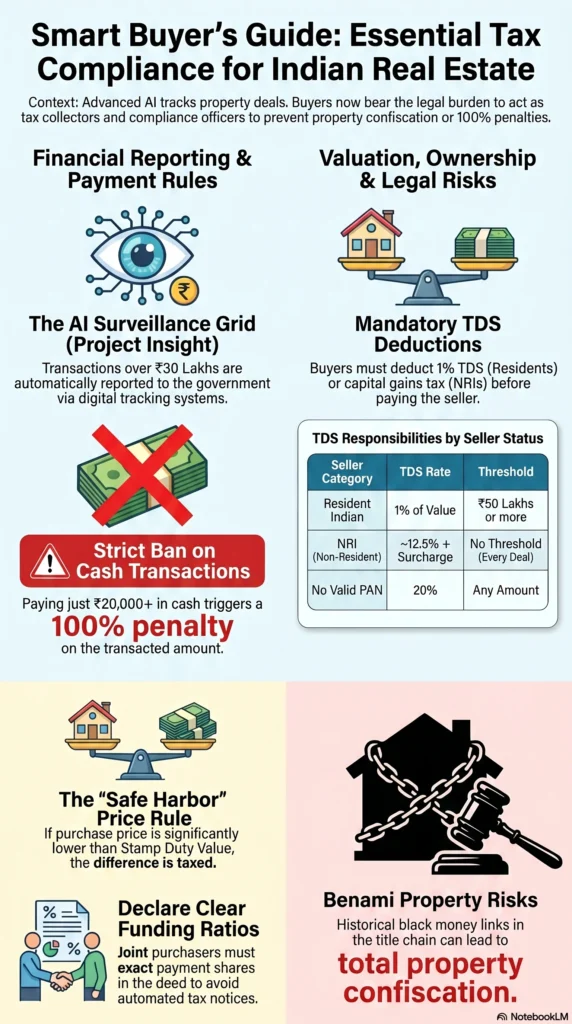
The days of unrecorded, opaque property deals are permanently over. Under Section 285BA and Rule 114E of the Income Tax Act, mandatory registration triggers an automatic alert. When you buy a property valued at ₹30 lakhs or more (based on transaction value or stamp duty value), the Sub-Registrar is legally obligated to report your transaction directly to the Income Tax Department via a Statement of Financial Transaction (Form 61A, SFT-012).
This data is instantly fed into “Project Insight,” the government’s advanced AI tracking system, which cross-matches your property purchase against your Annual Information Statement (AIS) and your declared tax returns. If your reported “white” income, savings, and loans do not mathematically justify the purchase, the system automatically triggers an e-verification prompt or a tax scrutiny notice.
- The End of Cash Transactions: The 100% Penalty
Using unaccounted cash in real estate is a financial death trap. To eradicate the parallel economy, the government strictly prohibits cash transactions, forcing buyers to use completely white, tax-paid income routed through banking channels:
- Section 269SS & 269T: You cannot pay an advance or receive a refund for a canceled property deal of ₹20,000 or more in cash.
- Section 269ST: Receiving or paying ₹2 lakhs or more in cash for a single transaction or event is strictly illegal.
The penalty for violating these rules is a massive 100% of the cash transacted. If you pay ₹5 lakhs in cash, the penalty levied is exactly ₹5 lakhs.
- Stamp Duty Value, the Safe Harbor Rule, and “Gift” Taxes
Historically, buyers undervalued properties on paper to save on registration costs. Today, Section 56(2)(x) ensures this is impossible. If you buy a property for a consideration that is less than the government-mandated Stamp Duty Value (SDV), the Income Tax Department treats the “discount” as your “Income from Other Sources” and taxes you on it.
- The Safe Harbor Rule: The law provides a slight tolerance limit. You are only protected from this tax if the difference between your purchase price and the SDV does not exceed ₹50,000 AND 10% of the consideration. If the gap is larger, you face a severe tax liability.
- Gift Tax Treatment: If you receive a property entirely without consideration (as a gift from a non-relative) and the SDV exceeds ₹50,000, the entire value is taxed as income in the hands of the buyer.
Navigating these valuation parity rules is highly complex. Utilizing a robust Property taxation consultancy service like ours is essential before locking in your purchase price.
- TDS Deductions: The Buyer’s Biggest Legal Responsibility
The government ensures the seller pays their capital gains tax by forcing the buyer to deduct Tax Deducted at Source (TDS) before the payment is even made.
- Resident Sellers (Section 194-IA): You must deduct 1% TDS if the property value is ₹50 lakhs or more. Following the Budget 2022 amendment, this 1% must be calculated on the actual sale consideration OR the Stamp Duty Value, whichever is higher.
- The New Aggregate Rule (Oct 1, 2024): A recent Finance Act 2024 amendment closed a major loophole. The ₹50 lakh threshold now applies to the aggregate consideration paid by all co-buyers to all co-sellers, meaning you can no longer split the property value among family members to escape TDS.
- NRI Sellers (Section 195): If the seller is a Non-Resident Indian (NRI), the rules change drastically. There is no ₹50 lakh exemption threshold. You must deduct TDS at the applicable capital gains rate—currently rationalized to 12.5% for Long-Term Capital Gains (post-Budget 2024), plus surcharge and cess.
- The PAN Crisis (Section 206AA): If the seller fails to provide a valid, Aadhaar-linked PAN, the buyer is legally forced to deduct TDS at a punitive rate of 20%.
Filing the multi-layered Form 26QB (for residents) or Form 27Q (for NRIs) incorrectly leads to severe daily interest and penalties. We highly recommend utilizing our TDS payment and filing consultancy at Shahnawaz and Associates to ensure flawless execution and the proper issuance of Form 16B to the seller.
- The Nightmare of Joint Purchases and Algorithmic Notices
Buying property jointly with a spouse—often just to secure slightly lower home loan interest rates—is incredibly common, but it is currently the biggest source of tax litigation in India.
If a housewife is added as a “nominal co-owner” purely for convenience on the registry, but the husband pays the entire amount, the Income Tax Department’s AI blindly assumes a 50:50 ownership split. Because the nominal co-owner’s tax returns will not reflect the financial capacity to justify a 50% property investment, the AI system automatically generates a terrifying reassessment notice under Section 148A.
While appellate tribunals and High Courts frequently rule that a mere “co-owner tag” without actual financial contribution shouldn’t trigger a tax addition , fighting these notices takes years of stressful litigation. To safeguard your family, the sale deed must explicitly state the funding ratios, and you must perfectly align your tax disclosures. This is where our specialized ITR filing consultancy in case of buying and selling the property becomes your ultimate safety net.
- The Existential Threat of the Benami Property Act
Beyond standard direct taxes, buyers face the severe threat of the Prohibition of Benami Property Transactions Act. If a property was historically bought with black money by a previous owner in someone else’s name, the title chain is contaminated. If investigating authorities declare the property “Benami,” the government possesses the absolute power to confiscate the property entirely, without paying the current owner a single rupee of compensation—even if you are an innocent buyer who paid with 100% white money. Exhaustive legal due diligence tracing the historical source of funds is now mandatory.
Protect Your Real Estate Investment with Shahnawaz and Associates
A real estate transaction in India is no longer a simple exchange of keys; it is a high-stakes tax audit waiting to happen. As a buyer, you are fully responsible for enforcing tax laws, monitoring the seller’s residential status, splitting TDS correctly among joint owners, and declaring every rupee properly.
Don’t leave your life savings to chance. At Shahnawaz and Associates, we provide end-to-end protection and expert advisory:
- Property taxation consultancy service: To structure your deal, conduct due diligence, and prevent costly Safe Harbor violations.
- TDS payment and filing consultancy: To ensure 100% accurate Form 26QB/27Q compliance and avoid compounding interest penalties.
- ITR filing consultancy in case of buying and selling: To align your AIS, prevent algorithmic joint-owner tax notices, and secure your financial peace of mind.
Ensure your property dream doesn’t become a legal nightmare. Contact Shahnawaz and Associates today before you sign your next property deed!