Why This Matters Right Now

Two government documents landed within days of each other in August 2026, and read together they tell a single story. On 14th August 2026, the CBDT notified the Foreign Assets of Small Taxpayers – Disclosure Scheme Rules, 2026 in the Gazette of India, opening a voluntary window for small taxpayers to disclose undisclosed foreign assets and income. Then, on 18th August 2026, the Department issued a press release announcing a nationwide verification exercise covering 394 entities and 36 professionals connected to suspicious foreign remittances.
This is not a coincidence of timing. It is the Department's now-familiar two-step playbook: open a low-cost compliance window, then immediately follow it with visible enforcement activity that makes staying outside that window materially riskier. Anyone with an undisclosed foreign bank account, an unreported overseas property, or foreign income not reflected in Schedule FA of their return needs to understand both documents together.
What is FAST-DS 2026?
The Foreign Assets of Small Taxpayers Disclosure Scheme, 2026 (FAST-DS) is a one-time voluntary disclosure scheme contained in Chapter IV (Sections 130 to 144) of the Finance Act, 2026. It allows eligible taxpayers to declare undisclosed foreign assets, undisclosed foreign income, or foreign assets that were simply left out of the relevant Schedule of their return — on payment of a specified tax or a flat fee, depending on the category.
The entire process is online. Declarations are filed electronically in Form 1, addressed to the Principal Director General of Income-tax (Systems) or the Director General of Income-tax (Systems).
The Government's Earlier Steps — And What They Achieved
FAST-DS 2026 does not arrive in a vacuum. It is the latest in a decade-long tightening of the net around undisclosed foreign assets, and understanding that history explains why this window is worth taking seriously.
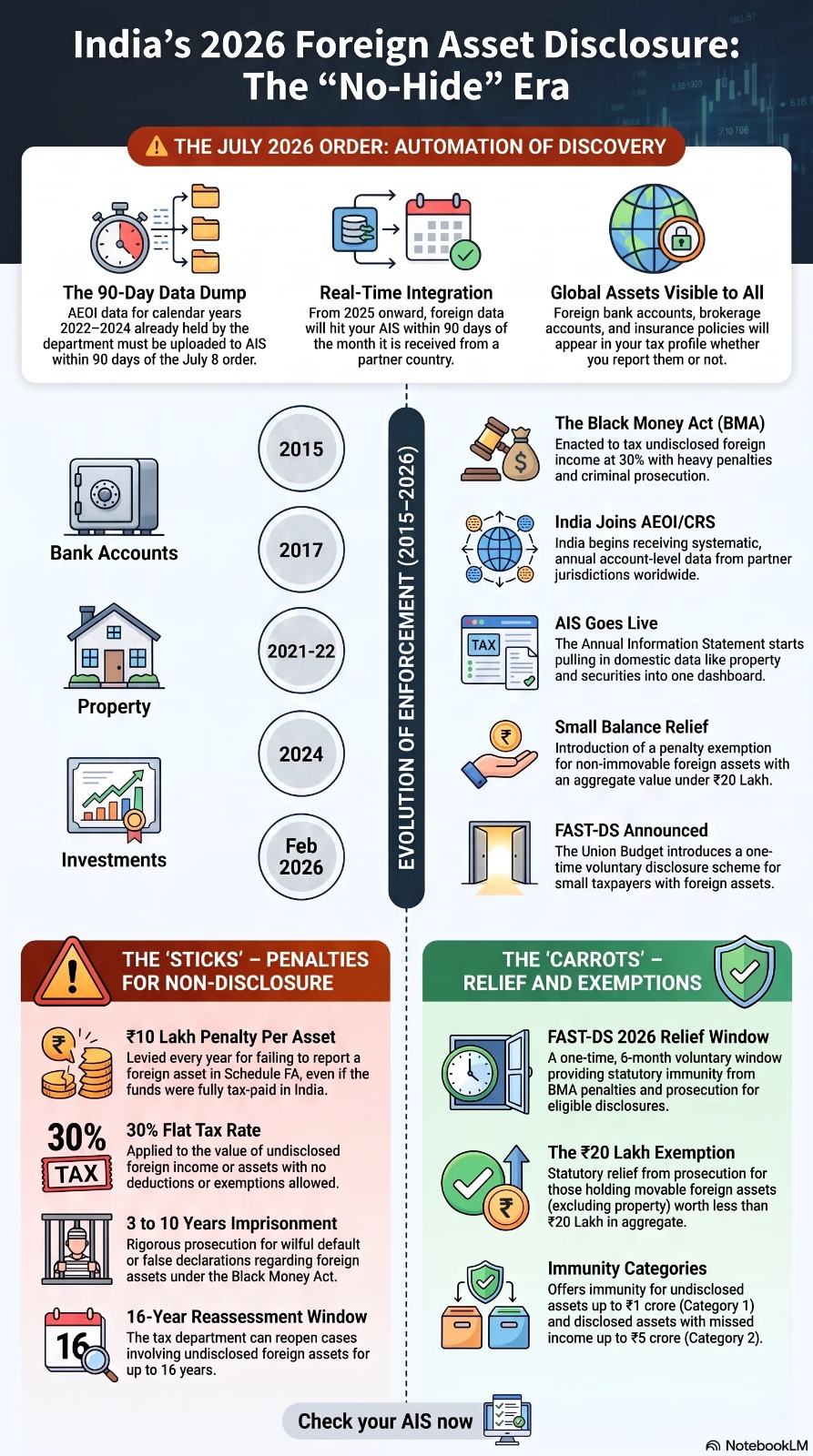
- 2015 — Black Money ActThe Black Money (Undisclosed Foreign Income and Assets) and Imposition of Tax Act, 2015 came into force, prescribing a steep 30% tax plus 90% penalty — effectively a 120% liability — on undisclosed foreign assets and income, along with prosecution risk. It gave taxpayers a one-time compliance window in 2015 itself, after which the harsh rigour became the default consequence of non-disclosure.
- 2017 onwards — CRS & FATCAIndia began receiving automatic annual data on Indian residents' offshore financial accounts from over 100 countries under the Common Reporting Standard and FATCA, giving the Department a growing repository of foreign account data independent of what taxpayers chose to disclose.
- 8 July 2026 — CBDT's AEOI OrderCBDT directed that Automatic Exchange of Information (AEOI) data — details of foreign bank accounts, custodial accounts and other financial assets received from partner jurisdictions — now be reflected directly in taxpayers' AIS and Form 26AS. We covered this in detail in Foreign Bank Accounts Now in Your AIS — CBDT AEOI Order 2026. The practical effect: a mismatch between what a taxpayer reports in Schedule FA and what AEOI data already shows in AIS is no longer something the Department needs to go looking for — it is visible on the taxpayer's own compliance portal.
- 14 August 2026 — FAST-DS Rules notifiedThe compliance window: a defined, time-bound opportunity to correct the record before AIS-flagged mismatches turn into scrutiny notices.
- 18 August 2026 — Nationwide verification driveThe enforcement signal: a press release confirming that the Department is actively cross-referencing foreign remittance data, Form 15CB certifications, and entity profiles to identify non-filers and mismatched disclosures.
The pattern from 2015 is instructive on results too. The original Black Money Act compliance window in 2015 saw limited disclosures relative to the scale of offshore holdings later uncovered through CRS/FATCA data and search operations — cases such as large undisclosed foreign asset detections during search actions in subsequent years (running into hundreds of crores in individual cases) show that a meaningful gap between disclosed and actual foreign holdings persisted well after that window closed. AEOI-linked visibility in AIS is designed to close exactly that gap, and FAST-DS 2026 is the government's way of giving taxpayers a defined off-ramp before that visibility gets used punitively rather than remedially.
The 18 August 2026 Press Release — What the Verification Drive Actually Found
The CBDT press release accompanying this Scheme is worth reading closely, because it explains exactly what triggers Departmental attention on foreign remittances. Based on ground intelligence and analysis of outward remittance data, the Department uncovered a network of entities — many operating through fictitious charitable trusts issuing bogus donation receipts — that were either non-filers or were filing returns showing turnover with no apparent correlation to the scale of funds remitted abroad. The stated purposes of these remittances (freight payments, software imports, consulting fees) frequently did not match the entities' actual activity, and several were found not to be operating from their declared addresses at all.
A separate and important finding concerns Form 15CB certification. The Department noted that a disproportionately large number of these certificates were issued by a relatively small group of professionals, and that the remitted funds were received by a clustered group of entities — raising direct questions about the due diligence exercised before certification.
The exercise is described as "detailed verification," and the Department has stated that further investigations are currently underway — meaning entities and professionals covered are likely to receive specific queries, not a blanket notice.
Who Can Declare Under FAST-DS 2026
An "assessee" eligible under the Scheme is a person who:
- is resident in India (as per Section 6 of the Income-tax Act, 1961) in the relevant previous year; or
- is currently a non-resident, or Resident but Not Ordinarily Resident (RNOR), but was resident in India either in the year to which the undisclosed foreign income relates, or in the year the undisclosed foreign asset was acquired.
This matters particularly for our NRI clients: a person who has since moved abroad and is now a non-resident can still use this Scheme, provided they were resident in India in the year the asset was acquired or the income arose. We've covered residency determination in detail in our ITR Filing for NRI guide — the RNOR and residency tests discussed there are directly relevant to establishing eligibility here.
A declaration can be made where the assessee has failed to furnish a return under Section 139, has failed to disclose the asset/income in a return filed before the Scheme commenced, or where the asset/income has escaped assessment within the meaning of Section 147.
What Can Be Declared
The Scheme recognises two distinct categories, each with its own monetary ceiling and cost:
| Category | Description | Monetary Threshold |
|---|---|---|
| Sl. No. 1 | Undisclosed foreign asset or undisclosed foreign income never offered to tax | Aggregate value/income must not exceed ₹1 crore |
| Sl. No. 2 | Foreign asset already offered to tax (or acquired while non-resident) but simply not disclosed in the relevant Schedule of the return | Aggregate asset value must not exceed ₹5 crore |
Category 2 is particularly relevant for taxpayers who genuinely paid tax on the income used to acquire a foreign asset but never ticked Schedule FA — a common, often inadvertent lapse we frequently encounter in NRI and returning-NRI filings.
Tax and Fee Payable
For Category 1 declarations, the total amount payable is the aggregate of:
- Tax at 30% of the value of the undisclosed foreign asset, or 30% of the undisclosed foreign income; plus
- An additional amount equal to that tax (i.e., 100% of the tax computed above)
In effect, this works out to 60% of the declared value/income — considerably lighter than the 120% exposure under a Black Money Act assessment.
| Item | Value/Income | Tax (30%) | Additional 100% of Tax | Total Payable |
|---|---|---|---|---|
| Foreign bank account | ₹60,00,000 | ₹18,00,000 | ₹18,00,000 | ₹36,00,000 |
| Foreign income | ₹20,00,000 | ₹6,00,000 | ₹6,00,000 | ₹12,00,000 |
| Total | ₹48,00,000 | |||
For Category 2 declarations, the cost is a flat fee of ₹1 lakh, regardless of asset value — provided the aggregate does not exceed ₹5 crore. Cross ₹5 crore, and the Scheme is not available at all for that declaration; the taxpayer falls back on regular assessment and, potentially, Black Money Act exposure.
Valuation of Foreign Assets (FMV)
Fair market value is generally computed as the higher of the cost of acquisition and the open-market price on the valuation date of 31 March 2026, ideally supported by a recognised valuer's report in the country where the asset is located. Where such valuation isn't carried out, the indexed cost of acquisition is deemed to be the FMV. Specific rules apply for different asset classes:
- Quoted shares/securities: higher of cost and the average of lowest/highest price on the valuation date (or nearest preceding trading date, if untraded that day)
- Unquoted equity shares: higher of cost and a prescribed formula based on net asset value
- Immovable property abroad: higher of cost and open-market price per a foreign government-recognised valuer's report
- Foreign bank accounts: the sum of all deposits made into the account since it was opened, up to the valuation date — with specific exclusions for amounts already declared under the 2015 Black Money Act window, and for re-deposits of the same withdrawn funds (to prevent double counting)
Where sale proceeds of one asset were reinvested into another (say, a foreign property sold and the proceeds partly used to buy a new one), the FMV of the original asset/account is reduced by the reinvested amount to avoid double counting — the new asset is valued separately on its own terms.
How to File — Process and Timelines
The entire declaration lifecycle runs electronically through four forms:
| Form | Purpose | Timeline |
|---|---|---|
| Form 1 | Declaration filed by the taxpayer, with supporting documents and valuation reports | Between 16 Aug 2026 and 31 Dec 2026 |
| Form 2 | Order from the Department communicating amount payable | Within 1 month from end of the month of declaration |
| Form 3 | Taxpayer's intimation of payment, with proof | Within 2 months from end of month Form 2 is received |
| Form 4 | Department's certificate confirming valid payment | Within 1 month from end of month Form 3 is received |
If payment cannot be made within the standard two-month window, a further two months is available with simple interest at 1% per month (or part thereof) of delay. Beyond that four-month outer limit from the Form 2 order, the Scheme benefit for that declaration lapses entirely — there is no further extension.
What You Get on a Valid Declaration
A valid declaration and payment brings immunity from further tax, penalty, and prosecution under the Black Money Act, 2015, for the income or asset declared. The declared amount is also excluded from total income under both the Income-tax Act, 1961 and the Black Money Act. Where assessment proceedings are already pending for the relevant year, the Assessing Officer is required to factor the declaration into the final order.
One important limitation: the Scheme gives no right to reopen or seek rectification of assessments already completed, nor to claim set-off or relief in pending appeals relating to that assessment. It is a forward-looking compliance route, not a retrospective correction mechanism.
Where the Scheme Does Not Apply
FAST-DS 2026 is unavailable for:
- Any income or asset that directly or indirectly represents proceeds of crime where PMLA proceedings have been initiated or are pending
- Any income or asset relating to an assessment year for which Black Money Act assessment proceedings have already been completed
Should You Act Now?
Reading the Scheme and the press release together, the message is direct: this is a defined, time-bound, and comparatively inexpensive route to regularise foreign holdings — running alongside an active verification exercise that specifically targets the kind of remittance-and-entity mismatches AEOI data now surfaces automatically in AIS. Taxpayers who wait for a notice lose access to the concessional 60% cost structure and the immunity from prosecution that only a voluntary declaration under this Scheme provides.
If you hold a foreign bank account, overseas property, foreign shares, or any offshore financial interest that hasn't been reported in Schedule FA — or has been reported inconsistently with what now appears in your AIS — this is the window to correct it. Given the FMV computation nuances (especially the deposit-tracing method for bank accounts) and the interplay with your existing return history, this is not a DIY exercise; an incorrect valuation or an eligibility miscalculation can forfeit the Scheme's protection altogether.
Considering a FAST-DS 2026 Declaration?
We help assess eligibility, compute FMV correctly under Rule 3, and prepare Form 1 with the right supporting documentation — before the 31 December 2026 deadline.
Book a ConsultationFrequently Asked Questions
Can an NRI who was a resident when the asset was acquired still declare under FAST-DS?
Yes. Eligibility extends to non-residents and RNORs who were resident in India either in the year the income arose or the year the asset was acquired.
What if my foreign assets exceed both the ₹1 crore and ₹5 crore thresholds?
You would not be eligible for either category of the Scheme and would need to address the disclosure through regular assessment channels, with Black Money Act exposure a real risk.
Is this the same as the Black Money Act 2015 compliance window?
No — FAST-DS 2026 is a fresh, separate one-time scheme under the Finance Act 2026, specifically scoped for smaller taxpayers with lower-value foreign holdings, with its own thresholds, cost structure, and forms.
Does filing under FAST-DS trigger scrutiny of my other income?
The Scheme is limited to the specific foreign asset or income declared; it does not itself extend to a review of unrelated domestic income, though existing assessment provisions continue to apply generally.
This article is based on the Finance Act, 2026 (Chapter IV), the Foreign Assets of Small Taxpayers – Disclosure Scheme Rules, 2026 (Gazette notification dated 14 August 2026), the official FAST-DS FAQs published by the Income Tax Department, and the CBDT press release dated 18 August 2026. Tax laws and scheme rules are subject to clarification and amendment; this is general information, not individual tax advice. Please consult our team at Shahnawaz & Associates before making a declaration.